





Changzhou Veidt Weighing Co., Ltd. © 2022 ALL RIGHTS RESERVED Privacy Policy | Calibration Weight | Test Weights | Cast Iron Weights | Standard Weights | Laboratory Weights | XML | SITEMAP
Product Category
Slot Hook Weight
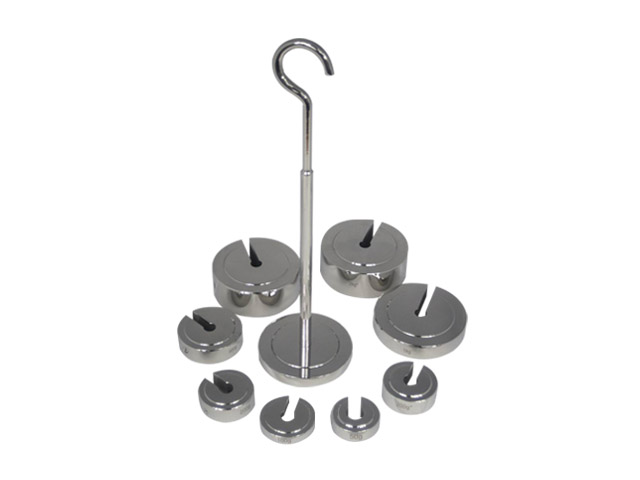
Slot hook weights and calibration weights are two core types of weight artifacts widely applied in physical experiment teaching, industrial measurement testing, mechanical tension testing, and daily precision weighing scenarios. Although both take mass calibration and force simulation as their core functional attributes, they differ significantly in structural design, dimensional specifications, material configuration, and applicable scenarios, forming a complementary weight system that meets diverse low-precision to high-precision measurement demands. Slot hook weights, also known as slotted hooked weights, are characterized by their integrated structure of a main weight body, top suspension hook, and bottom embedded slot, which allows single independent use and multi-piece stacked combination assembly, making them highly flexible for dynamic force testing and gravity demonstration experiments. Calibration weights, as standard mass reference artifacts, focus on dimensional uniformity, mass stability, and surface flatness, serving as the benchmark for correcting various weighing instruments and verifying measurement accuracy. An in-depth understanding of the morphological characteristics, material properties, processing technologies, and application boundaries of these two weights is essential for standardizing measurement operations, improving experimental accuracy, and extending the service life of weighing equipment.
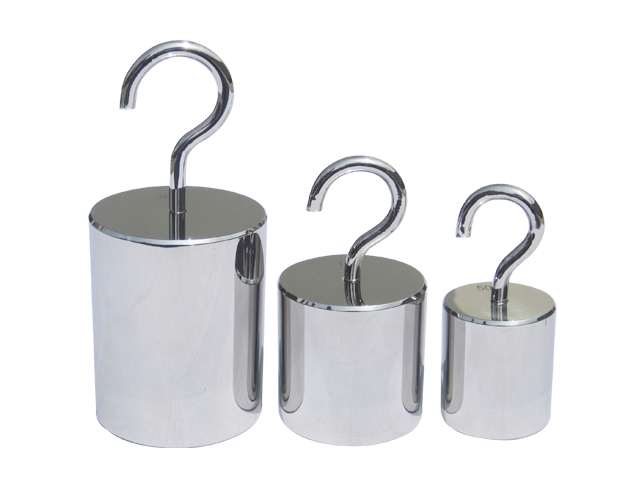
The morphological structure and shape design of slot hook weights are tailored to portable assembly and hanging testing requirements, with mainstream shapes including cylindrical main bodies and square prismatic main bodies, among which cylindrical slot hook weights occupy the dominant market share due to their uniform stress and convenient stacking performance. The overall structure of a complete slot hook weight consists of three integrated parts: an upper suspension hook, a middle weight main body, and a lower limit slot. The suspension hook is usually designed as a circular arc closed or semi-closed open structure, with smooth arc transitions at the connection with the weight body to avoid stress concentration and prevent breakage during long-term hanging tension. The middle weight body is the main mass-bearing part, with a solid interior structure to ensure uniform density and stable mass distribution. The bottom slot is a key structural feature that distinguishes it from ordinary hook weights; the groove width and depth are precisely matched with the upper hook size of the same series of weights, enabling multiple weights to be stably nested and stacked vertically without lateral displacement or tipping. Different shape designs correspond to different usage scenarios: cylindrical slot hook weights are suitable for conventional physical teaching experiments and small tension tests, while square prismatic slot hook weights are more applicable for flat surface placement and fixed-direction load testing, with better anti-slip performance in horizontal superposition states.
Calibration weights adopt a more standardized and concise shape design centered on mass stability and calibration accuracy, with common shapes including cylindrical knob type, flat plate type, block type, and spherical type, each adapted to different calibration environments and instrument types. Cylindrical knob-type calibration weights are the most widely used, featuring a smooth cylindrical main body and a small integrated knob on the top for convenient manual handling and placement, effectively avoiding fingerprint contamination and surface wear caused by direct contact with the weight body. Flat-plate calibration weights are thin and uniform in thickness, suitable for calibrating flat weighing platforms and micro-weighing instruments with limited placement space. Block-type calibration weights have regular cuboid shapes with flat and vertical surfaces, which can be stably placed in superposition and are often used for large-range mass calibration. Spherical calibration weights have an all-round smooth structure with no angular dead corners, ensuring uniform force bearing during rotating calibration tests and avoiding local wear affecting mass accuracy. Unlike slot hook weights, calibration weights have no additional hooks or slots, and their overall structure is compact and integrated, with strict control over surface flatness, roundness, and verticality in processing to eliminate measurement errors caused by morphological irregularities.
In terms of specification models and nominal mass values, slot hook weights cover a wide range of conventional and medium-sized mass segments, with complete gradient nominal values to meet the superposition combination needs of different load forces. The mainstream nominal values of single slot hook weights include 5g, 10g, 20g, 50g, 100g, 200g, 500g, and 1000g, forming a continuous mass gradient from micro-load to medium-load. Small-specification slot hook weights below 50g are mostly used for micro-gravity demonstration and small tension balance experiments in primary and secondary school physics teaching; medium-specification products from 50g to 500g are the most commonly used, adapting to most conventional mechanical experiment scenarios such as friction force testing and spring elasticity verification; large-specification 1000g slot hook weights are mainly used for industrial small-component load bearing tests and mechanical tension limit detection. The dimensional specifications of each nominal value are matched in proportion: the height and diameter of the cylindrical weight body increase synchronously with the nominal mass, and the size of the top hook and bottom slot is uniformly designed within the same product series to ensure universal stacking compatibility. Each slot hook weight is clearly marked with a permanent nominal mass value on the side surface, with clear and wear-resistant font printing to avoid mass identification errors during long-term use.
The specification system and nominal value setting of calibration weights are more refined and hierarchical than those of slot hook weights, covering ultra-micro, conventional, medium, and large mass segments, realizing full-range coverage of precision calibration. The nominal values of calibration weights range from 1mg ultra-micro specifications to 50kg large specifications, with extremely dense gradient intervals. Ultra-micro calibration weights including 1mg, 2mg, 5mg, 10mg, 20mg, 50mg, and 100mg are mainly used for calibrating high-precision analytical balances and micro-weighing instruments in laboratories; small and medium specifications from 0.2g to 1000g are applicable to daily calibration of electronic scales, platform scales, and precision weighing equipment; large calibration weights above 2kg are mostly used for accuracy verification of industrial large-scale weighing instruments and truck scales. Different from the fixed gradient of slot hook weights, the nominal value design of calibration weights follows the principle of decimal gradient matching, which can flexibly combine different single weights to realize arbitrary mass value calibration within the full range. The specification dimensions of calibration weights are strictly optimized according to mass and material density, ensuring that the volume error of each weight is controlled within a tiny range, and the nominal mass value maintains long-term stability without obvious drift due to volume changes.
Material selection determines the core physical properties such as density, hardness, and oxidation resistance of the two types of weights, and also directly affects their service life and application accuracy. Slot hook weights mostly adopt high-purity carbon steel, cast iron, and aluminum alloy as the main raw materials, with different materials corresponding to different use strengths and environmental adaptability. Carbon steel slot hook weights have moderate density, high structural hardness, strong impact resistance, and are not easy to deform during stacking and hanging tension, making them the most versatile material type with a density range of 7.8g/cm³ to 7.9g/cm³. Cast iron slot hook weights have higher density, reaching 7.2g/cm³ to 7.4g/cm³, with lower production cost, suitable for large-batch teaching and conventional industrial use, but slightly poor in toughness and prone to surface chipping under strong impact. Aluminum alloy slot hook weights have a low density of 2.7g/cm³, light overall weight, convenient to carry and operate, and are not easy to rust, making them suitable for outdoor mobile experiment scenarios and frequent handling use. All materials of slot hook weights are solid forged or integrally cast, with uniform internal texture, no pores or impurities, ensuring consistent density of the weight body and avoiding mass deviation caused by internal structural defects.
Calibration weights put forward higher requirements on material purity, density uniformity, and chemical stability, and the mainstream materials include stainless steel, brass, and high-density alloy, with individual ultra-precision products adopting tungsten alloy materials. Stainless steel calibration weights are the most widely used, with a density of 7.93g/cm³, featuring excellent corrosion resistance, oxidation resistance, and wear resistance, no rust or deformation in long-term indoor and dry industrial environments, and stable mass retention, suitable for daily precision calibration scenarios. Brass calibration weights have a density of 8.5g/cm³ to 8.7g/cm³, with fine surface texture, good machinability, high finish after processing, and stable chemical properties, often used for laboratory high-precision calibration and instrument verification. Tungsten alloy ultra-precision calibration weights have a high density of 18.5g/cm³ to 19.0g/cm³, with small volume under the same mass, low air buoyancy impact, and extremely high mass stability, specially adapted for ultra-precision weighing calibration in high-end laboratories and precision manufacturing fields. The materials of calibration weights all undergo strict purification treatment and aging treatment to eliminate internal stress, ensure uniform density of the weight body, and avoid mass changes caused by material fatigue and chemical reactions.
Surface treatment processes are key technical means to improve the durability, anti-corrosion performance, and identification clarity of weights, and the treatment methods of slot hook weights and calibration weights are significantly different due to different use environments and precision requirements. The surface treatment of slot hook weights focuses on wear resistance, anti-rust, and anti-scratch performance, with common processes including powder coating, electro-galvanizing, spray painting, and polishing. Powder coating treatment forms a thick and uniform protective film on the surface of carbon steel and cast iron slot hook weights, with strong adhesion, impact resistance, and scratch resistance, effectively isolating air and moisture to prevent rust and oxidation, and the coating color is uniform, which is convenient for unified identification and management. Electro-galvanizing treatment forms a thin and dense zinc layer on the metal surface, with good anti-corrosion performance, suitable for slot hook weights used in humid environments. Partial aluminum alloy slot hook weights adopt mechanical polishing and anodizing treatment to improve surface finish, while enhancing oxidation resistance and avoiding surface oxidation and darkening after long-term use. The surface treatment of slot hook weights appropriately reduces the precision requirements of surface flatness, focusing on practical protection functions to adapt to frequent stacking, collision, and hanging use.
The surface treatment of calibration weights takes high precision, non-pollution, and stability as the core standards, with extremely strict process control, and common processes including mirror polishing, fine grinding, passivation treatment, and anti-fingerprint coating. Stainless steel and brass calibration weights all undergo multi-channel fine grinding and mirror polishing treatment, making the surface smooth and flat without burrs, pits, and scratches, reducing dust adhesion and avoiding surface residual impurities affecting calibration accuracy. Passivation treatment is a key anti-corrosion process for high-precision calibration weights, which forms a dense inert protective film on the metal surface through chemical treatment, without changing the surface size and mass of the weight, and can long-term resist oxidation, corrosion, and chemical erosion. Ultra-precision calibration weights will also be coated with a thin anti-fingerprint protective film to prevent sweat and grease contamination during manual handling, avoiding local corrosion and mass change caused by human contact. All surface treatment processes of calibration weights will not change the nominal mass of the weight body, and the surface thickness error is controlled at an extremely low level to ensure the consistency of calibration reference performance.
The functional uses of slot hook weights are concentrated in physical experiment demonstration, mechanical performance testing, and load simulation, with prominent advantages of flexible combination and dynamic adaptation. In basic physics teaching, slot hook weights are used for classical experiments such as verifying the law of gravity, exploring the relationship between friction force and pressure, testing spring elastic force, and demonstrating force balance, realizing intuitive gravity loading and tension simulation through single hanging and multi-layer stacking. In industrial testing, they are applied to small mechanical component tension testing, equipment load-bearing limit detection, and structural stability verification, simulating the static load and dynamic tension of mechanical parts under different working conditions. In addition, slot hook weights can also be used for daily tool calibration of simple weighing tools, auxiliary leveling of mechanical equipment, and gravity debugging of small experimental devices. Thanks to the nested slot and hook structure, multiple weights can be quickly assembled into integrated load components, realizing stepless adjustment of load force within a certain range, which greatly improves the flexibility of experimental and testing operations, and is suitable for scenario environments that do not require ultra-high precision but need frequent load adjustment.
Calibration weights are specialized standard reference artifacts, whose core function is to provide accurate mass benchmarks for various weighing and measuring equipment, covering precision calibration, accuracy verification, instrument debugging, and measurement error correction in all fields. In laboratory scenarios, calibration weights are used for regular calibration of analytical balances, precision electronic balances, and micro-weighing instruments to eliminate measurement errors caused by instrument aging and parameter drift. In industrial production and commodity detection, they are applied to the accuracy verification of electronic platform scales, truck scales, belt scales, and other weighing equipment, ensuring the accuracy and consistency of industrial weighing data and commodity metering. In precision manufacturing and processing fields, calibration weights are used for mass detection and parameter debugging of precision parts, providing accurate mass reference for product quality inspection. Different from the flexible use of slot hook weights, calibration weights are used in a single and standardized manner, requiring placement in a stable, dust-free, and constant-temperature environment, and are forbidden from collision, stacking, and random hanging, so as to long-term maintain the accuracy of standard mass values and ensure the reliability of measurement and calibration work.
