





Changzhou Veidt Weighing Co., Ltd. © 2022 ALL RIGHTS RESERVED Privacy Policy | Calibration Weight | Test Weights | Cast Iron Weights | Standard Weights | Laboratory Weights | XML | SITEMAP
Product Category
In the modern industrial and logistics ecosystem, efficient weight measurement of palletized cargo has become an indispensable link in daily operational management, and pallet scales have emerged as a core specialized weighing device tailored to this precise scenario. Unlike traditional fixed platform scales that require independent station setup and separate cargo handling procedures, pallet scales integrate cargo transportation and weight detection into a single operational process, breaking the operational barriers between material handling and data collection that have long restricted warehouse and logistics efficiency. This integrated equipment is evolved from conventional pallet handling tools, embedded with high-sensitivity sensing and digital signal processing modules, enabling real-time weight acquisition while operators complete pallet cargo lifting, moving and stacking. Its birth and popularization are rooted in the industry’s growing demand for streamlined processes, data refinement and operational cost control, gradually replacing fragmented weighing modes and becoming a standard configuration for medium and large-scale material management scenarios. What distinguishes pallet scales most from general industrial weighing equipment is their mobile operational attribute and scenario adaptability, allowing weighing operations to be carried out at any position in the working area without being limited by fixed station boundaries, which fundamentally optimizes the spatial and temporal efficiency of cargo weight detection.
The internal working logic of pallet scales is built on mature strain-gauge load cell sensing technology, which serves as the core support for all weighing functions and data output. The key sensing components are strategically installed inside the fork beam or bearing structure of the equipment, usually arranged in a symmetric multi-point layout to ensure uniform force bearing and comprehensive pressure detection of pallet cargo. When a pallet loaded with goods is lifted and placed on the scale’s bearing surface, the gravity of the cargo acts vertically on the load cells, causing tiny elastic deformation of the internal strain gauges inside the sensors. This physical deformation is instantly converted into continuous analog electrical signals, whose intensity changes in direct proportion to the actual weight of the loaded cargo. The embedded digital processing module in the equipment receives these original electrical signals, filters out interference signals generated by mechanical vibration, ground friction and operational jitter through built-in algorithm programs, and calibrates and converts valid signals into accurate weight data. The entire signal collection and processing process is completed in milliseconds, realizing real-time display and stable output of weight values, and the multi-point sensing layout effectively avoids data deviation caused by slight off-center loading of cargo, ensuring high accuracy and repeatability of each weighing result.
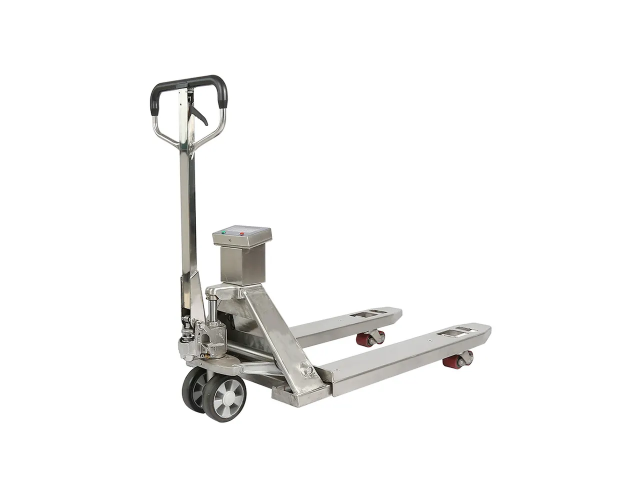
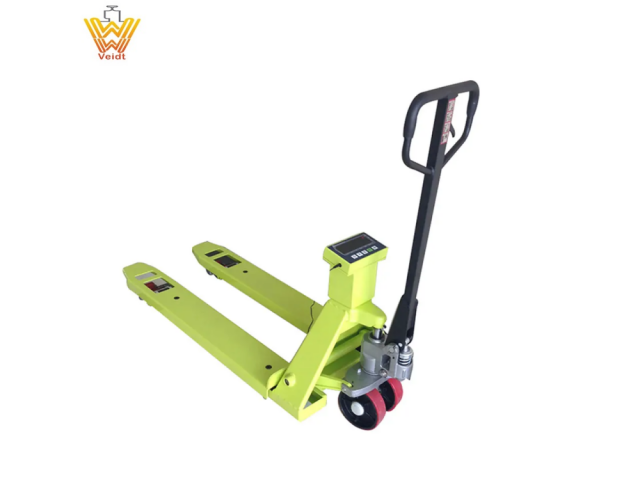
The structural design of modern pallet scales fully balances mechanical durability, operational flexibility and weighing stability, adapting to the complex and high-frequency working environment of industrial sites. The main body of the equipment adopts high-strength alloy steel materials, which undergo professional anti-corrosion, anti-wear and anti-deformation treatments to cope with long-term friction, impact and heavy-load pressure in warehouse handling operations. The fork structure is designed with optimized beam thickness and arc transition, which not only meets the structural strength requirements for lifting heavy pallet cargo, but also ensures smooth insertion and extraction of pallets of different specifications, reducing operational resistance. The bottom walking mechanism is equipped with wear-resistant solid rollers and flexible steering components, enabling stable movement on flat cement floors, patterned workshop floors and conventional logistics pavement, without obvious jitter or displacement during weighing. The data display terminal is installed at the operator’s eye level, with a high-definition digital screen that maintains clear visibility in strong light, dim light and complex dust environments. Meanwhile, the whole machine adopts an integrated sealing design for core electronic components, which can effectively isolate dust, moisture and minor oil pollution in the working environment, ensuring continuous and stable operation of sensing and data processing modules in long-term industrial scenarios.
Standardized operational procedures are the key to ensuring the long-term accuracy and stable performance of pallet scales, and normative operation habits can effectively reduce data errors and equipment loss in daily use. Before each batch of weighing operations, operators need to complete basic equipment inspection work, including checking the flexibility of the walking mechanism, the flatness of the bearing fork surface, and the normal standby state of the data display terminal, to eliminate hidden troubles such as roller jamming and screen failure. When placing pallet cargo, it is necessary to ensure that the pallet is completely and stably placed on the middle bearing area of the fork, avoiding unilateral stress, overhanging placement and stacking offset, because uneven force distribution will cause local overload of individual load cells and lead to inaccurate weighing data. During the lifting and moving process, operators should maintain a stable operating speed, avoid sudden start, sudden stop and sharp steering, and reduce mechanical vibration and inertial impact on the sensing components. After the equipment is stabilized, the data displayed on the terminal is the effective weight value of the cargo. After completing the weighing operation, the equipment should be unloaded in time, and the fork should be lowered to the lowest horizontal position to keep the internal stress of the mechanical structure in a relaxed state, which helps prolong the service life of core components.
Pallet scales have achieved in-depth penetration in multiple industrial scenarios, bringing substantial efficiency improvements and management optimization to different links of material operation. In intelligent warehouse management scenarios, the equipment supports real-time weighing and data recording during cargo inbound, storage transfer and outbound delivery. Operators can complete cargo handling and weight verification in one step, eliminating the need for secondary transportation of goods to fixed weighing stations, greatly shortening the inbound and outbound processing cycle of pallet goods. In manufacturing production workshops, pallet scales are applied to the whole-process weight monitoring of raw material receiving, semi-finished product turnover and finished product delivery. Accurate weight data can reflect the consumption of production materials and the output of finished products in real time, providing reliable data support for production scheduling, material cost accounting and process optimization. In logistics distribution and freight operation links, the mobile weighing function of pallet scales realizes on-site weight confirmation of bulk pallet goods before dispatch, avoiding weight deviation problems in transit links, and providing accurate basis for cargo sorting, load matching and delivery arrangement.
The popularization of pallet scales has profoundly optimized the traditional industrial operation model, bringing dual improvements in operational efficiency and economic benefits for enterprises. In the traditional material management mode, cargo handling and weighing are two independent processes, which require repeated handling, stacking and waiting for weighing station queuing, resulting in low overall operational efficiency and high labor time cost. Pallet scales break this segmented operation mode, realizing the integration of handling and weighing, reducing nearly half of the intermediate transfer links in the material operation process. The simplified operational process not only improves the daily processing capacity of warehouse and workshop cargo, but also reduces the labor intensity of operators and lowers the human resource input required for single cargo processing. At the same time, the accurate real-time weighing data effectively avoids weight errors caused by manual estimation and repeated measurement, reduces operational disputes and resource waste caused by data deviation, and improves the refined management level of enterprise materials. For long-term industrial operation, the efficient and stable working performance of pallet scales can continuously reduce time cost, labor cost and error loss cost, forming a stable cost-control advantage for enterprise operational management.
With the continuous upgrading of industrial digitalization and intelligent technology, pallet scales have completed iterative upgrades from basic mechanical weighing to intelligent digital interaction, and functional diversification has become an important development feature of modern products. Early pallet scales only had single real-time weight display function, with simple data output form and no data storage and transmission capability, which could only meet the most basic weighing needs. Modern pallet scales are equipped with intelligent data processing chips and wireless communication modules, realizing automatic storage, real-time upload and remote synchronization of weighing data. All weighing records can be automatically sorted and archived according to operation time and cargo batches, forming traceable electronic data files, which is convenient for enterprise managers to conduct data query, statistical analysis and operational supervision at any time. Some upgraded models are also equipped with intelligent check-weighing function, which can automatically identify overweight or underweight unqualified goods during weighing operation, and send prompt signals to operators, realizing real-time quality screening of cargo weight and further improving the standardization of cargo management.
The environmental adaptability of pallet scales enables them to maintain stable working performance in various complex industrial working conditions, which is an important reason for their wide application in diversified scenarios. In conventional indoor warehouse environments with constant temperature and low dust, the equipment can maintain long-term high-precision operation with minimal performance attenuation. For humid and semi-enclosed processing environments such as food processing and light industry manufacturing, the sealed electronic component design and moisture-proof structural treatment of pallet scales can effectively prevent circuit failure and sensing deviation caused by humid air, ensuring the stability of weighing data in high-humidity environments. For open and semi-open logistics transfer yards with large temperature differences and serious dust accumulation, the high-temperature and low-temperature resistance of core components and the dust-proof and anti-pollution design of the whole machine can adapt to the temperature changes of different seasons and the dusty working environment, without frequent calibration failure or equipment failure due to environmental interference. In addition, the equipment can also adapt to narrow operation spaces such as dense warehouse storage areas and small workshop operation areas, relying on its flexible walking and compact structural design, completing accurate weighing operations in limited spatial ranges.
Daily maintenance and scientific calibration are essential guarantees to maintain the long-term accuracy and service life of pallet scales, and standardized maintenance management can effectively avoid equipment failure and data deviation. In daily maintenance work, operators need to regularly clean the equipment surface, focusing on removing dust, sundries and residual stains on the fork bearing surface and walking rollers, to prevent foreign matter from affecting the bearing balance and walking stability. It is necessary to regularly check the connection state of internal sensing components and circuit lines, ensure that the lines are intact and the components are firmly installed, and avoid data disorder caused by loose wiring or component displacement. The movable rotating parts of the walking mechanism need regular lubrication maintenance to keep the walking flexible and prevent jitter and noise during operation. In terms of calibration management, due to the slight performance attenuation of sensing components caused by long-term heavy-load operation and mechanical wear, regular professional calibration is required to correct data deviation. Timely calibration can restore the weighing accuracy of the equipment, ensure that each weighing data is true and effective, and avoid operational risks and economic losses caused by inaccurate data.
Compared with other traditional industrial weighing equipment, pallet scales show unique comprehensive advantages in scenario adaptability, operational efficiency and use cost, and gradually become the mainstream weighing solution for pallet cargo. Fixed platform scales need to occupy independent site space, and all goods need to be transported to the fixed station for weighing, which has great limitations in operational flexibility and is difficult to adapt to mobile and high-frequency cargo weighing needs. Handheld portable scales are small in size and flexible to use, but have limited load-bearing capacity and low weighing accuracy, and cannot meet the weighing requirements of heavy pallet bulk goods. Forklift-mounted weighing equipment has strong load-bearing capacity, but it has high use threshold and high equipment investment cost, and is not suitable for small and medium-batch frequent weighing operations. In contrast, pallet scales combine the advantages of mobility, high precision, moderate load-bearing capacity and low use cost, which can perfectly match the daily weighing operation needs of most warehouses, workshops and logistics sites, with low equipment investment and simple operation and maintenance, achieving a high cost-performance balance in industrial weighing scenarios.
In the context of continuous progress in industrial intelligent manufacturing and modern logistics industry, the market demand for pallet scales is showing a steady growth trend, and the equipment will also usher in more in-depth technical optimization and functional upgrading. Future pallet scale products will further improve the intelligent level of data management, realize seamless connection with enterprise warehouse management systems and production management systems, and complete automatic data docking, statistical analysis and report generation, realizing full digital closed-loop management of weighing data. In terms of hardware performance, the sensing accuracy, environmental adaptability and load-bearing stability of the equipment will be further optimized, which can adapt to more extreme industrial working conditions and meet the refined weighing needs of high-precision industrial scenarios. At the same time, the equipment will develop towards lightweight, energy-saving and intelligent human-computer interaction, reducing operational difficulty, improving continuous working capacity, and further adapting to the efficient and intelligent development trend of modern industrial material management.
As a practical and efficient integrated industrial weighing equipment, pallet scales have broken the limitations of traditional weighing modes, optimized the whole process of industrial cargo weighing and handling, and provided strong technical support for enterprises to realize refined, efficient and digital material management. Its unique integrated working mode, stable and accurate weighing performance, flexible scenario adaptability and low operation and maintenance cost make it an indispensable basic equipment in modern industrial and logistics fields. With the continuous upgrading of industrial management standards and the continuous improvement of intelligent operation requirements, pallet scales will continue to exert their core value in more industrial scenarios, help enterprises reduce operational costs, improve management efficiency, and promote the standardized and intelligent development of the whole industrial material handling link.
