





Changzhou Veidt Weighing Co., Ltd. © 2022 ALL RIGHTS RESERVED Privacy Policy | Calibration Weight | Test Weights | Cast Iron Weights | Standard Weights | Laboratory Weights | XML | SITEMAP
Product Category
Cast Iron Weight
Cast iron weights and test weights are fundamental mass reference artifacts widely deployed in industrial weighing verification, equipment calibration, and daily weight detection scenarios, serving as core physical carriers for transmitting mass values in various measurement environments. Although the two types of weights overlap in functional attributes and application scenarios in many cases, they differ significantly in material composition refinement, structural design, performance orientation, and application pertinence, forming a complementary mass measurement product system that adapts to different precision and usage intensity requirements. Cast iron weights, as a traditional and mature mass measuring tool, are favored for their stable physical properties, excellent structural rigidity, and cost-effective manufacturing characteristics, making them the most commonly used basic weights in heavy-duty industrial measurement fields. Test weights, as a generalized functional classification of measuring weights, cover multiple material types including cast iron and fine metal materials, focusing more on standardized testing applicability and universal calibration compatibility, and can be flexibly matched with various weighing equipment to complete routine testing and accuracy verification work. In actual industrial production and metrological detection work, a clear understanding of the material characteristics, structural specifications, and usage differences between cast iron weights and conventional test weights is essential to ensure the accuracy and stability of weighing data, avoid measurement errors caused by improper weight selection, and improve the overall reliability of industrial measurement and detection links.
The material characteristics of cast iron weights constitute the core foundation of their service performance, and their unique physical and chemical properties determine their applicable scenarios and service life compared with other types of test weights. The main raw material of cast iron weights is high-purity cast iron alloy formed by smelting iron-based raw materials with a reasonable proportion of carbon, silicon, manganese and other trace elements, with no excessive impurity components such as sulfur and phosphorus that affect measurement stability. The compact internal metal structure of qualified cast iron materials avoids loose pores and structural voids, ensuring long-term mass stability and effectively preventing quality deviation caused by internal structural changes during long-term use. In terms of core physical parameters, the density of cast iron weights is maintained in a stable range, with a conventional density of approximately 7200 kilograms per cubic meter, and the density fluctuation range of finished products is extremely small after precise smelting and casting processes. This moderate density enables cast iron weights to achieve a compact volume under large nominal mass values, facilitating handling, stacking and storage in industrial scenarios, while avoiding the excessive volume and space occupation problems of low-density material weights. In contrast, test weights include diversified material types, and their density varies greatly with materials. Fine metal test weights have a higher density close to 7850 kilograms per cubic meter, while partial alloy test weights have a slightly lower density, forming a multi-density product system to adapt to different precision measurement needs. The material hardness and wear resistance of cast iron are far superior to ordinary alloy test weights, with strong resistance to mechanical collision and friction damage, which makes cast iron weights more suitable for high-frequency and high-intensity industrial operation environments.
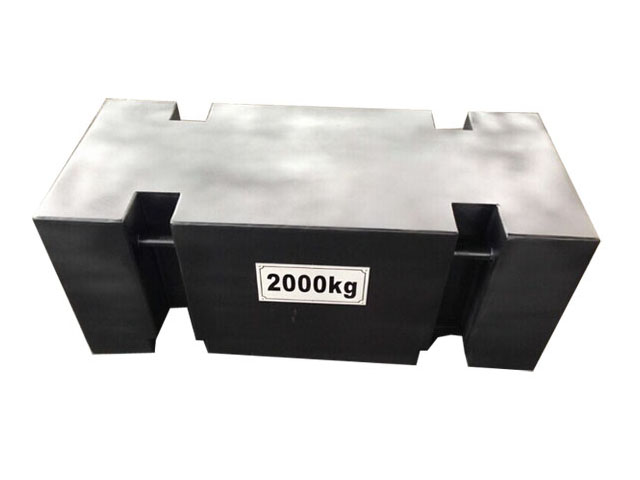
Nominal mass value is the most basic core parameter of both cast iron weights and test weights, and the complete nominal value series covers all conventional measurement ranges required for industrial and civil weighing detection. The nominal value setting of cast iron weights is mainly oriented to medium and large mass measurement scenarios, with a complete gradient from small mass to super-large mass. The conventional small nominal values include 1kg, 2kg, 5kg, 10kg and 20kg, which are mostly used for the calibration of small and medium-sized weighing equipment such as platform scales and electronic bench scales. The medium nominal values cover 50kg, 100kg, 200kg and 500kg, adapting to the detection of medium-sized weighing equipment such as truck scales and packaging weighing instruments. The large nominal values include 1000kg, 2000kg and other super-large specifications, which are specially used for the calibration and testing of large-scale industrial weighing equipment such as weighbridges and heavy-duty crane scales. The nominal value system of test weights is more comprehensive and refined, covering ultra-small mass milligram-level specifications to large-tonnage specifications, realizing full-range coverage of precision laboratory detection and industrial heavy-duty testing. Ultra-small test weights with nominal values of milligram and gram levels are mostly made of high-precision metal materials, while kilogram-level and above medium and large nominal value test weights are mostly made of cast iron materials, which balances precision requirements and use cost. All nominal values are marked clearly on the weight surface through professional processing technology, with clear and durable markings that are not easy to wear and fade during long-term use, ensuring that staff can quickly identify the mass specification in daily operation and avoid measurement errors caused by nominal value confusion.
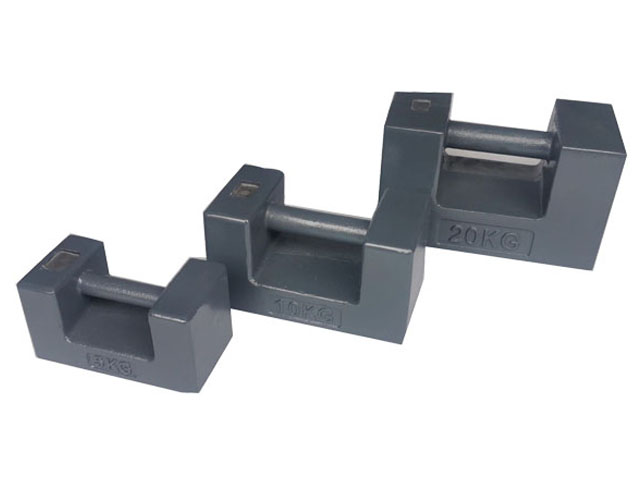
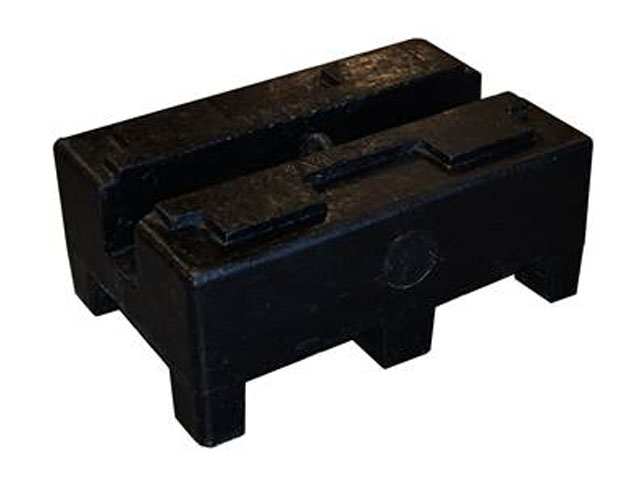
Diversified shape designs of cast iron weights and test weights are developed around actual use scenarios, handling convenience and stacking stability, and different shape structures correspond to unique functional advantages and applicable environments. The mainstream shapes of cast iron weights include rectangular block type, cylindrical type and special handle integrated type, among which rectangular block cast iron weights are the most widely used. This shape features flat and smooth upper and lower surfaces and neat side edges, enabling stable multi-layer stacking without sliding and tilting, which is very suitable for centralized storage and batch calibration operations. Cylindrical cast iron weights have a uniform circular structure with no sharp edges and corners, reducing collision damage during handling and transportation, and are often used in dynamic weighing testing scenarios with frequent movement. The handle integrated cast iron weight is optimized for humanized operation, with an integral casting handle on the upper part of the weight body, which is convenient for single-person or mechanical lifting and carrying, and is mostly applied to medium and large nominal value products above 10kg. The shape design of test weights is more diverse and refined on the basis of cast iron weight shapes, including disc type, ring type, sheet type and other special shapes in addition to conventional block and cylindrical structures. Disc and ring test weights are mostly small and micro nominal value products, which can be sleeved on weighing detection equipment for auxiliary calibration, while sheet test weights are ultra-thin in structure, suitable for precision micro-mass adjustment and fine calibration of high-sensitivity balances. All shape designs follow the principles of mechanical stability and operational practicability, ensuring that weights can maintain structural integrity and placement stability in different detection environments.
Surface treatment technology is a key process that affects the service life, appearance integrity and measurement stability of cast iron weights and test weights, and different treatment processes are selected according to material characteristics and use environment. The surface of raw cast iron has natural metal roughness and is prone to oxidation rust and corrosion when exposed to humid air for a long time, so professional anti-corrosion and decorative surface treatment is essential for finished cast iron weights. The most conventional surface treatment method for cast iron weights is multi-layer paint coating treatment, including bottom anti-rust paint and surface finish paint. The bottom paint can effectively isolate the cast iron matrix from air and moisture, preventing oxidation corrosion and rust generation, while the surface finish paint forms a smooth and wear-resistant protective layer, reducing surface friction and avoiding surface damage caused by frequent handling and collision. Some high-demand cast iron weights adopt two-component composite coating treatment, which has stronger scratch resistance, impact resistance and weather resistance, and can adapt to harsh working environments such as outdoor humidity and dust. For fine test weights made of high-precision metal materials, the surface treatment process is more refined, including polishing, passivation and anti-oxidation coating treatment. The polished surface eliminates tiny burrs and uneven structures, ensuring the consistency of weight surface contact state during calibration, while passivation treatment can improve the chemical stability of the metal surface, effectively resisting oxidation and chemical corrosion, and maintaining long-term surface finish and measurement accuracy. All surface treatment processes will not change the nominal mass value and internal structural performance of the weight, only playing a protective and decorative role.
The classification types of cast iron weights can be divided into multiple dimensions according to structural design, use function and adjustment mode, forming a systematic product classification system to meet differentiated use needs. According to the structural adjustment function, cast iron weights are divided into adjustable type and fixed type. Adjustable cast iron weights are designed with internal adjustment cavities, and staff can fine-tune the internal balance filler according to actual measurement deviation to ensure that the mass of the weight is consistent with the nominal value, which is suitable for long-term repeated use and regular calibration scenarios. Fixed cast iron weights adopt an integral casting structure with no internal adjustable cavity, with fixed and stable mass, simple structure and low failure rate, and are mostly used for conventional daily weighing testing with low precision adjustment frequency. According to the carrying structure, cast iron weights are divided into handle type, flat block type and suspension type. Handle type weights are convenient for manual handling, flat block type weights are suitable for stacking storage, and suspension type weights are specially designed for suspension weighing equipment testing, with reserved suspension structures to ensure stable stress during detection. According to the use environment, they can be divided into indoor conventional type and outdoor weather-resistant type. Outdoor cast iron weights adopt enhanced surface anti-corrosion treatment and optimized casting structure, which can resist wind, rain and temperature changes, and maintain stable performance in open-air industrial environments. Test weights have a broader classification scope, which can be divided into cast iron test weights, stainless steel test weights and alloy test weights according to materials, and into routine detection type, precision calibration type and experimental test type according to functional purposes, covering all levels of measurement detection needs from industrial rough detection to laboratory precision calibration.
The core application scenarios of cast iron weights are concentrated in industrial heavy-duty weighing detection, mechanical equipment debugging and daily metrological verification, relying on their stable material properties and strong environmental adaptability to complete high-intensity measurement work. In the field of industrial weighing equipment calibration, cast iron weights are the main matching artifacts for weighbridges, truck scales, crane scales and other large-scale weighing equipment, and complete the accuracy verification and error correction of large-range weighing equipment through single or combined stacking use. In mechanical manufacturing and equipment debugging, cast iron weights are used for load testing and bearing capacity detection of mechanical equipment such as elevators, conveyor belts and lifting machinery, simulating the actual load state of the equipment to ensure the safety and stability of mechanical operation. In commercial and industrial daily metrological supervision, cast iron weights are used for regular spot checking and calibration of various platform scales, floor scales and packaging weighing instruments to ensure the accuracy of weighing data in production and trading links. In addition, cast iron weights are also widely used in construction engineering, logistics warehousing and other fields, for load detection of building structures and weight calibration of logistics sorting equipment. Due to their strong impact resistance and low maintenance cost, cast iron weights can adapt to complex industrial environments such as dust, humidity and frequent collision, which cannot be replaced by high-precision lightweight test weights in heavy-duty application scenarios.
Test weights undertake more diversified and refined measurement tasks, covering laboratory precision calibration, instrument precision detection, experimental data verification and high-standard metrological testing, forming a complementary application system with cast iron weights. In laboratory precision measurement scenarios, high-precision metal test weights are used for regular calibration of analytical balances, precision electronic balances and micro-weighing instruments, providing accurate mass reference for scientific experiments, material testing and precision detection. In the field of instrument manufacturing and testing, test weights of different specifications are used for factory calibration and performance testing of newly produced weighing instruments to ensure that the precision indexes of the equipment meet the design requirements. In scientific research experiments, test weights are used for physical experiment verification, material gravity detection and mechanical stress testing, providing accurate mass parameter support for experimental data analysis. In daily metrological inspection and commodity detection, small-specification test weights are used for precision detection of small electronic scales, jewelry scales and medicinal scales to ensure the accuracy of miniature weighing equipment. Different from the heavy-duty application orientation of cast iron weights, test weights focus more on precision, refinement and versatility, and can adapt to multi-scene and multi-precision measurement needs from micro-mass detection to conventional mass testing, making them indispensable basic artifacts in precision metrology fields.
The structural design details of cast iron weights fully consider the practical needs of industrial use, and have obvious advantages in structural stability, wear resistance and operation convenience. The integral high-temperature casting process adopted by cast iron weights makes the internal metal structure uniform and dense, with no loose pores or structural defects, ensuring that the mass will not drift or deviate due to internal structural changes during long-term use. The edge and corner parts of cast iron weights are specially rounded and thickened, which effectively avoids structural damage and mass loss caused by frequent collision and friction in the handling process, and improves the overall durability of the product. The stacking surface of the weight body is processed by flat grinding to ensure high flatness, so that multiple weights can be closely stacked without shaking or sliding during combined use, improving the stability of calibration operation. The internal adjustable cavity of partial cast iron weights is arranged in the center of the weight body, with uniform stress distribution, which will not affect the overall structural balance and mass uniformity of the weight after filling and adjusting the balance material. The bottom of large-specification cast iron weights is designed with anti-slip grooves, which increases the friction with the placement surface, avoids displacement during load-bearing detection, and further improves the accuracy of weighing test data. These humanized and practical structural designs make cast iron weights highly adaptable and stable in long-term industrial application.
The precision maintenance and mass stability characteristics of cast iron weights and test weights vary with materials and processes, forming different service cycle and maintenance requirements. Cast iron weights have excellent long-term mass stability, and their metal structure will not produce obvious fatigue deformation and mass loss under conventional use environments. After professional surface anti-corrosion treatment, they can resist daily oxidation and corrosion, and the mass deviation is extremely small after years of use, with low frequency of regular calibration and maintenance. Due to the large structural volume and heavy mass of cast iron weights, they are not easy to produce accidental displacement and mass change, and can maintain stable measurement performance in high-frequency industrial use. High-precision metal test weights have higher initial precision, but their surface is easy to be affected by environmental humidity, dust and manual contact grease, resulting in tiny surface oxidation and quality change, so they need regular cleaning and precision calibration maintenance. Small-specification test weights with fine structure are easy to produce tiny deformation and wear after frequent use, which affects the measurement accuracy, so the service life is relatively shorter than that of cast iron weights. In terms of daily maintenance, cast iron weights only need regular surface cleaning and rust prevention treatment, with simple maintenance process and low use cost, while precision test weights need to be stored in a constant temperature and dry environment, avoiding dust pollution and mechanical collision, with higher maintenance and storage requirements.
The matching and selection logic of cast iron weights and test weights in actual measurement work is mainly based on detection precision requirements, use environment and mass range, realizing scientific and reasonable weight configuration. For heavy-duty industrial weighing equipment with large mass range and low precision error limit, such as industrial weighbridges and heavy-load lifting scales, cast iron weights are the preferred choice due to their stable structure, strong environmental adaptability and low cost. For precision weighing instruments and laboratory experimental equipment with high precision requirements and small mass range, high-precision metal test weights need to be selected to meet the requirements of micro-error calibration and detection. In conventional medium-precision daily detection scenarios, cast iron test weights can be used preferentially, which not only ensures basic detection accuracy, but also gives play to the cost advantage and durability of cast iron materials. In batch combined calibration work, weights of different nominal values can be matched and used according to the detection range, with large-specification cast iron weights undertaking main load detection and small-specification test weights completing fine error correction. Reasonable selection of weight types can not only ensure the accuracy and reliability of measurement data, but also effectively reduce equipment use and maintenance costs, and improve the overall efficiency of metrological detection work.
As basic and core mass measuring artifacts, cast iron weights and test weights undertake the important task of mass value transmission and weighing accuracy guarantee in industrial production, commercial transactions and scientific research detection fields. Cast iron weights rely on their stable material properties, solid structural design, diversified shape specifications and excellent environmental adaptability to become the mainstream choice for heavy-duty industrial weighing detection, with irreplaceable advantages in high-intensity, complex environment and large-mass measurement scenarios. Test weights, with their diversified material systems, complete nominal value series and refined structural design, cover all precision detection needs from micro-mass to conventional mass, providing accurate and reliable mass reference for high-precision metrology and scientific experimental research. The two types of weights have their own functional advantages and application boundaries, forming a complete mass measurement artifact system through complementary matching. In the actual use process, fully mastering their material characteristics, specification types, surface treatment characteristics, shape differences and application ranges can effectively avoid measurement errors caused by improper selection and use, ensure the long-term stability and accuracy of weighing and detection work, and provide solid basic support for the standardized operation of industrial measurement, commercial metrology and scientific research experiments.
