





Changzhou Veidt Weighing Co., Ltd. © 2022 ALL RIGHTS RESERVED Privacy Policy | Calibration Weight | Test Weights | Cast Iron Weights | Standard Weights | Laboratory Weights | XML | SITEMAP
Product Category
The spring balance stands as one of the most fundamental and enduring mechanical measuring devices ever devised, serving as a reliable tool for quantifying force and weight across countless everyday, educational, and industrial scenarios. Unlike complex electronic measuring instruments that rely on circuit boards, sensors, and power sources, the spring balance operates entirely through simple mechanical motion, leveraging the inherent physical properties of elastic materials to deliver consistent, intuitive measurements. Its simplicity of design, portability, and independence from external power supplies have secured its place in basic scientific experimentation, routine weight checking, and field measurement tasks for centuries. Even in an era dominated by digital precision equipment, the spring balance remains indispensable, particularly in environments where electronic devices may fail due to temperature fluctuations, electromagnetic interference, or power shortages. At its core, this device transforms invisible mechanical force into visible, readable linear displacement, turning abstract physical quantities into tangible data that users can observe and record directly. This seamless conversion of force to motion is the key reason why the spring balance has maintained its practical value through generations of technological advancement, bridging the gap between theoretical physics principles and real-world measurement applications accessible to both professionals and ordinary users.
The entire functional logic of a spring balance is rooted in Hooke’s Law, a foundational principle of classical physics that defines the elastic behavior of solid materials under applied force. This physical rule establishes that the extension or compression of an elastic spring within its linear elastic limit is directly and linearly proportional to the magnitude of the external force applied to it. In practical terms, this means that as the weight of a suspended object increases, the spring stretches by a correspondingly equal incremental distance, and as the weight decreases, the spring retracts in a consistent linear fashion. Crucially, this proportional relationship only holds true within the spring’s elastic threshold; once the applied force exceeds the spring’s maximum elastic capacity, the material undergoes permanent plastic deformation, losing its ability to return to its original shape and rendering the balance inaccurate or completely non-functional. This core physical mechanism differentiates spring balances from comparative balance scales that rely on counterweights and gravitational equilibrium. While traditional balance scales measure mass by comparing unknown loads to standard reference masses, spring balances measure weight, which is the gravitational force acting on a mass. This distinction is subtle yet critical, as it means spring balance readings can vary slightly with changes in gravitational acceleration across different altitudes and planetary environments, a characteristic that underscores its direct reliance on force measurement rather than mass comparison.
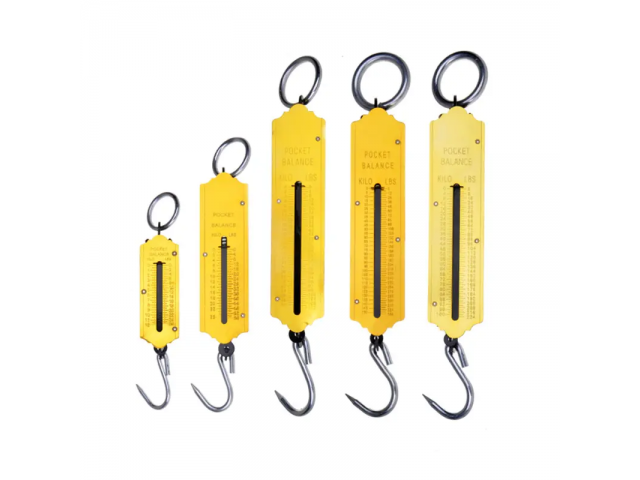
A standard spring balance features a streamlined, integrated mechanical structure composed of several core components, each with a specialized function that collectively ensures stable and accurate measurement performance. The central component is a precision-engineered coiled elastic spring, typically fabricated from high-tensile alloy materials selected for their consistent elasticity, fatigue resistance, and resistance to environmental corrosion. One end of this spring is rigidly fixed to the upper inner frame of the balance, creating a stable anchor point that prevents unnecessary movement during measurement. The opposite end of the spring connects to a lightweight pointer and a load-bearing hook or flat weighing pan, the latter serving as the contact point for holding or suspending objects under measurement. Enclosing these internal mechanisms is a protective outer casing, usually made of durable lightweight material, which shields the delicate spring and pointer assembly from physical impact, dust, moisture, and airborne debris that could disrupt movement or cause wear over time. Printed or engraved on the outer surface of the casing is a graduated linear scale with evenly spaced markings, calibrated to translate the spring’s extension distance into standard weight or force units. Additional small structural details include a top hanging ring for suspending the balance from fixed supports and internal limit stops that prevent excessive spring stretching to avoid permanent deformation during overload incidents.
The operational process of a spring balance follows a straightforward, repeatable sequence of mechanical movements that users can easily master with minimal practice. Before taking any measurement, the device must be placed in a stable vertical orientation, with the top hanging ring secured to a stationary, rigid support to eliminate external vibration or movement interference. At this initial state, the pointer should align precisely with the zero marking on the graduated scale; most standard models include a small zero-adjustment mechanism to fine-tune alignment and eliminate baseline offset errors caused by minor structural wear or assembly tolerance deviations. Once zero calibration is complete, the object to be measured is gently suspended from the bottom hook or placed centrally on the weighing pan, ensuring that the entire load acts vertically downward without lateral tilting or twisting force. The downward gravitational force exerted by the load pulls the movable end of the spring, causing uniform elastic extension. As the spring stretches, the attached pointer glides smoothly along the graduated scale until the tension force generated by the deformed spring perfectly balances the downward gravitational force of the load. At this static equilibrium state, the pointer stabilizes at a fixed position, and the corresponding scale marking directly indicates the weight or force value of the measured object. After recording the reading, removing the load allows the spring to retract fully to its original resting position, ready for subsequent measurements.
Spring balances find extensive application across a diverse spectrum of fields, ranging from basic science education to routine industrial and daily measurement tasks. In educational settings, they serve as essential teaching tools for middle and high school physics curricula, enabling students to intuitively observe and verify Hooke’s Law, explore the relationship between mass, weight, and gravitational force, and conduct simple force-measurement experiments. The visible mechanical movement of the spring and pointer makes abstract physical theories concrete, fostering hands-on scientific understanding far more effectively than theoretical instruction alone. In daily life, lightweight spring balances are commonly used for quick, casual weighing tasks, such as measuring the weight of groceries, luggage, or small household items, offering convenient portable measurement without the need for fixed weighing equipment. In industrial and workshop environments, medium and high-range spring balances assist technicians in detecting tensile force, checking component load capacity, and conducting routine quality inspections of small parts. They are also widely utilized in agricultural scenarios for weighing harvested crops, feed materials, and small livestock, providing reliable on-site measurement in outdoor field conditions where electronic devices are impractical. Additionally, specialized compact spring balances are applied in laboratory settings for preliminary force testing and low-precision weight verification tasks.
The precision and measurement performance of a spring balance are determined by a combination of structural design parameters and material characteristics, with distinct performance gradients across different model specifications. The elasticity coefficient of the core spring is the primary factor influencing measurement sensitivity; springs with smaller elasticity coefficients produce greater extension displacement under minimal force, enabling higher sensitivity for measuring light loads, while stiffer springs with larger elasticity coefficients are designed for heavy-load measurement with wider weighing ranges. The accuracy of the graduated scale also plays a vital role, as finely divided scale markings allow users to capture smaller measurement increments and obtain more precise readings. Structural rigidity further impacts performance: a robust, deformation-resistant frame ensures that all applied force acts solely on the spring rather than causing structural bending or displacement, eliminating systemic measurement deviations. Well-manufactured spring balances maintain excellent linearity within their rated measurement range, meaning the scale markings remain evenly spaced and the force-displacement relationship stays consistent throughout the entire working interval. Beyond basic accuracy, high-quality models exhibit strong repeatability, delivering nearly identical readings for repeated measurements of the same load, and minimal mechanical hysteresis, ensuring that spring extension and retraction follow consistent paths without lag or offset.
Despite their simple structure, spring balances are susceptible to a variety of measurement errors stemming from environmental factors, operational irregularities, and material aging, all of which users must recognize and mitigate to preserve reading accuracy. Environmental interference includes air friction acting on the pointer during movement, which can slightly slow pointer stabilization and cause minor reading deviations, as well as temperature fluctuations that alter the elastic properties of the spring material—extreme cold can increase spring stiffness, while high temperatures can reduce elasticity, both disrupting the linear force-displacement relationship. Operational errors are the most common source of inaccuracy, including failure to perform zero calibration before use, improper load placement that generates lateral or torsional force, and reading the scale from an oblique angle, which creates visual parallax errors. Overload usage represents the most damaging factor: applying force beyond the spring’s elastic limit causes permanent structural deformation, destroying the linear proportional relationship and leading to persistent baseline drift and inaccurate measurements. Long-term natural aging also contributes to error accumulation, as prolonged repeated stretching and retraction causes material fatigue, gradually reducing spring elasticity and leading to slow, cumulative measurement deviation over extended service periods.
Proper routine maintenance and standardized operating practices are essential to extend the service life of a spring balance and sustain its long-term measurement stability and accuracy. Daily use requires strict adherence to the device’s rated measurement range, with absolute avoidance of overload conditions to prevent irreversible spring damage. Before each use, users must inspect the device for visible structural defects, including frame deformation, pointer bending, spring rust or distortion, and unsmooth pointer movement, and perform zero calibration to correct baseline offsets. During measurement operations, the balance must be kept strictly vertical, and loads must be applied gently and centrally to prevent sudden impact force or lateral stress on the spring and internal components. After use, the device should be wiped clean of dust, moisture, and residual debris using a soft dry cloth, with special attention to keeping the spring and scale markings clear and unobstructed. For long-term storage, spring balances should be placed in a dry, cool, dust-free environment away from corrosive substances, high temperatures, and heavy pressure. It is critical to avoid storing loaded balances for extended periods, as continuous static tension will accelerate spring fatigue and deformity. Regular periodic calibration is also necessary for frequently used devices to correct minor accumulated deviations and ensure consistent measurement reliability over time.
The evolution of the spring balance spans centuries of mechanical innovation, reflecting continuous improvements in material science, structural design, and manufacturing precision. The earliest primitive spring-based weighing devices emerged from basic observations of elastic material deformation, utilizing simple metal strips and crude scale markings to achieve rudimentary force measurement with limited accuracy and stability. Early models suffered from significant drawbacks, including poor material elasticity consistency, prone rusting and wear, rough scale graduation, and narrow effective measurement ranges, restricting their application to only the simplest rough weighing tasks. As metallurgical technology advanced, higher-purity alloy spring materials were developed, offering more stable elasticity, superior fatigue resistance, and better environmental adaptability, laying the foundation for modern spring balance performance improvements. Subsequent structural optimizations introduced integrated protective casings, precision zero-adjustment mechanisms, smoother pointer sliding systems, and refined graduated scale engraving techniques, greatly enhancing measurement accuracy, operational convenience, and structural durability. Modern manufacturing processes have further standardized spring balance production, ensuring uniform elastic performance across individual springs, consistent scale calibration, and minimized structural assembly errors, transforming the device from a rough experimental tool into a mature, reliable mainstream measuring instrument.
Compared with other common weighing and force-measuring devices, spring balances possess unique inherent advantages that maintain their irreplaceable status in specific application scenarios. Foremost among these is their complete mechanical independence: spring balances require no power supply, no electronic components, no software systems, and no external auxiliary equipment, enabling normal operation in any environment, including remote field locations, extreme temperature conditions, and sites with no power access where electronic scales cannot function. Their ultra-portable, lightweight, compact structure allows for easy carrying and quick deployment, supporting on-site random measurement tasks with high flexibility. The intuitive working principle and visible mechanical movement make their measurement logic easy to understand and verify, with no hidden algorithmic or electronic errors, delivering high measurement credibility for basic applications. In addition, spring balances feature simple structure, low failure rates, and convenient maintenance, with no complex parts requiring specialized repair or replacement, resulting in extremely low long-term use and maintenance costs. Unlike comparative balance scales that require matched standard weights, spring balances integrate the entire measurement system into a single compact unit, enabling independent, one-step measurement operations with higher efficiency for routine simple weighing tasks.
While spring balances offer prominent practical advantages, they also have inherent functional limitations that define their applicable scope and prevent their replacement of high-precision measuring equipment. The most notable limitation is their relatively low measurement accuracy compared to electronic precision scales and analytical balances, making them unsuitable for high-precision scientific research, laboratory precision analysis, and industrial high-accuracy quality detection scenarios. Their core reliance on spring elasticity also introduces inherent performance constraints: all elastic materials undergo gradual fatigue deformation with prolonged use, leading to slow, unavoidable accuracy attenuation over time, requiring regular calibration and eventual component replacement. Additionally, spring balance measurements are affected by gravitational variations, meaning readings for the same mass object will differ slightly at different altitudes or in different gravitational environments, limiting their application in scenarios requiring strict mass measurement consistency. The linear elastic range constraint further restricts their versatility—each individual spring balance only maintains accurate performance within a fixed measurement interval, failing to adapt to both ultra-light micro-load and ultra-heavy large-load measurement tasks simultaneously. Moreover, manual reading operations inevitably introduce subjective visual errors, further limiting the upper limit of measurement precision.
Looking ahead, the development of spring balance technology continues to advance steadily alongside progress in material science and precision manufacturing, focusing on optimizing core performance and expanding application adaptability. Modern material innovation is driving the development of new elastic alloy materials with more stable elasticity, stronger fatigue resistance, and superior corrosion and temperature resistance, effectively slowing accuracy attenuation and extending service life. Structural optimization designs are integrating more precise zero-adjustment structures, anti-shake pointer systems, and anti-overload protective mechanisms to further reduce operational errors and improve measurement stability. Combined application designs are also emerging, integrating basic mechanical spring balance structures with auxiliary reading aids to reduce visual parallax errors while retaining full mechanical independence and portability. In terms of application expansion, improved spring balances are being adapted for specialized scenarios, including low-temperature resistant models for polar field operations, corrosion-resistant models for chemical industry environments, and high-sensitivity micro-measurement models for fine engineering testing. Despite the rapid development of digital and intelligent measuring equipment, the unique mechanical simplicity, extreme reliability, and environmental adaptability of spring balances ensure that they will continue to occupy an important niche in the field of measurement tools, serving as a fundamental, practical, and indispensable device for basic force and weight measurement in diverse scenarios for the foreseeable future.
