





Changzhou Veidt Weighing Co., Ltd. © 2022 ALL RIGHTS RESERVED Privacy Policy | Calibration Weight | Test Weights | Cast Iron Weights | Standard Weights | Laboratory Weights | XML | SITEMAP
Product Category
Analytical Balance
As a core high-precision weighing instrument indispensable in modern laboratory scientific research, industrial detection, and academic experimental analysis, the analytical balance is designed to capture tiny mass changes of substances that cannot be identified by ordinary weighing equipment. Different from conventional precision scales that only meet macroscopic weighing needs, analytical balances focus on micro and trace mass measurement scenarios, featuring ultra-high sensitivity, stable measurement performance, and strict environmental adaptability design. The core working logic of modern analytical balances is based on advanced electromagnetic force balance and strain sensor technology, which converts the gravity of the measured sample into measurable electrical signals, and realizes digital high-precision reading through internal circuit processing and algorithm calibration. Widely applied in chemical component analysis, pharmaceutical ingredient testing, material science research, environmental monitoring, and food safety detection, this type of instrument has become a basic guarantee for the accuracy and repeatability of experimental data in various precision research fields. With the continuous upgrading of laboratory testing standards and the deepening of micro-analysis research, the structural design, functional configuration, and performance parameters of analytical balances are constantly optimized, deriving multiple types of equipment suitable for different measurement ranges and precision levels, forming a complete product system covering conventional trace measurement to ultra-micro trace detection.
Analytical balances can be divided into multiple core categories according to measurement precision, weighing range, and application scenarios, each with independent structural characteristics and targeted application directions. The most widely used conventional analytical balance is the basic type of such equipment, with a mature structural design and stable operational performance, which is suitable for most conventional laboratory trace weighing experiments. On the basis of conventional models, semi-micro analytical balances are upgraded in precision and sensitivity, narrowing the weighing range while significantly improving the resolution of tiny mass changes, making them suitable for semi-trace sample detection in chemical analysis and biological experiments. Micro analytical balances belong to high-end precision models, with extremely low measurable minimum mass and ultra-high reading accuracy, mainly used for trace component analysis in pharmaceutical research and fine chemical testing. Ultra-micro analytical balances represent the highest precision level of current weighing equipment, which can capture ultra-trace mass changes at the microgram level and is exclusively applied in cutting-edge fields such as nanomaterial research, molecular biology experiments, and ultra-fine ingredient analysis. In addition, special functional analytical balances including moisture analytical balances and constant-temperature weighing analytical balances have been derived for special experimental scenarios, which integrate environmental adjustment functions on the basis of precise weighing to meet the detection needs of volatile, moisture-containing, and temperature-sensitive samples.
The application scenarios of analytical balances cover almost all fields that require high-precision mass measurement, with strong industry universality and experimental pertinence. In chemical laboratories, it is mainly used for the accurate weighing of experimental reagents, the preparation of standard solutions, the quantitative analysis of chemical reaction products, and the detection of trace impurities in raw materials, providing accurate basic data for chemical reaction ratio calculation and component content analysis. In the pharmaceutical industry, analytical balances are applied in the weighing of pharmaceutical raw materials, the detection of trace active ingredients in finished drugs, the quantitative analysis of pharmaceutical auxiliary materials, and the quality inspection of pharmaceutical intermediates, ensuring the accuracy of drug formula ratio and the stability of drug quality. In material science research, the equipment is used for weighing ultra-fine powder materials, nanomaterial samples, and composite material components, supporting the research and development of new materials and the analysis of material component proportion. In environmental monitoring, it can accurately weigh trace pollutants in water bodies, soil, and air sediments, providing data support for environmental pollution assessment and governance effect detection. In addition, analytical balances are also widely used in food safety testing, agricultural product component analysis, forensic scientific identification, and university teaching experiments, becoming an indispensable basic testing instrument in scientific research and industrial production.
Modern analytical balances have significant functional and performance advantages compared with traditional mechanical balances and ordinary electronic scales, laying the foundation for their dominant position in precision weighing fields. First of all, they have ultra-high measurement accuracy and sensitivity, which can identify tiny mass changes that are difficult to capture by ordinary weighing equipment, effectively meeting the detection requirements of trace and ultra-trace samples. Secondly, the equipment has extremely high measurement stability, with built-in vibration compensation, temperature drift correction, and air convection suppression functions, which can offset the interference of external environmental slight changes on weighing results and ensure the repeatability and consistency of multiple measurement data. In terms of operation efficiency, modern analytical balances adopt intelligent digital sensing technology, with fast stabilization speed, which can complete accurate weighing in a short time and greatly improve experimental detection efficiency. In addition, the equipment has strong anti-interference ability, through anti-static coating and electromagnetic shielding structure, it can avoid the influence of static electricity, electromagnetic signals, and dust on weighing accuracy. The intelligent calibration function is also a core advantage, supporting automatic internal calibration and manual external calibration, which can automatically correct system errors caused by long-term use and environmental changes, maintaining long-term measurement accuracy.
The specification and model system of analytical balances is rich and complete, forming a graded product layout according to weighing range, reading accuracy, and functional configuration, covering all precision weighing scenarios from conventional laboratory experiments to cutting-edge scientific research. Conventional standard analytical balance models are designed for daily laboratory use, with a medium weighing range and conventional precision parameters, focusing on cost performance and stable basic performance, and are suitable for most undergraduate teaching experiments and conventional industrial routine detection. Semi-micro analytical balance models are positioned in mid-to-high-end conventional precision detection, with a reduced weighing range but improved reading resolution, which is more suitable for fine chemical analysis and biological sample trace detection. Micro analytical balance models belong to high-precision professional models, with a smaller effective weighing range and ultra-fine reading accuracy, specially used for professional scientific research laboratories and high-standard quality inspection institutions. Ultra-micro analytical balance models are top-level professional equipment, with ultra-low minimum weighing limit and ultra-high precision resolution, exclusively serving high-precision scientific research fields such as nanotechnology, molecular biology, and aerospace material detection. In addition, differentiated models derived for special scenarios have targeted structural and functional optimizations, such as moisture-measuring analytical balances with built-in heating modules and constant-temperature analytical balances with independent temperature control systems, meeting the personalized detection needs of special samples.
The core performance parameters of analytical balances determine their weighing capacity and application scope, involving multiple key indicators such as weighing range, readability, repeatability, linear error, stabilization time, and working environment parameters. The weighing range refers to the maximum effective sample mass that the instrument can accurately measure, which varies greatly among different types of analytical balances. Conventional models usually have a weighing range of 100g to 500g, semi-micro models are mainly concentrated in 30g to 100g, micro models are 2g to 30g, and ultra-micro models are limited within 10g, realizing gradual refinement of weighing range with the improvement of precision. Readability is the most core precision parameter, representing the minimum mass change value that the instrument can identify. Conventional analytical balances have a readability of 0.0001g, semi-micro models reach 0.001mg, micro models can achieve 1μg, and ultra-micro models can accurately identify 0.1μg ultra-trace changes. Repeatability parameters reflect the stability of the instrument's repeated weighing, referring to the maximum error of multiple measurements of the same sample under the same environment, and high-quality analytical balances can control the repeatability error within an extremely tiny range. Linear error represents the accuracy deviation of the instrument in different load ranges, which is an important indicator to ensure the uniform accuracy of full-scale weighing.
In addition to core precision parameters, analytical balances also have complete structural and electrical parameter indicators that support stable operation. The stabilization time refers to the time required for the instrument to complete data stabilization and accurate reading after placing the sample. Modern optimized models have a stabilization time of only a few seconds, which greatly improves experimental efficiency compared with traditional slow-response equipment. The working temperature range is usually controlled between 18℃ and 28℃, with a suitable environmental humidity of 45% to 75% non-condensing, which ensures that the internal sensor and circuit system will not have parameter drift due to temperature and humidity changes. In terms of power parameters, the equipment supports wide-voltage power supply adaptation, with a voltage adaptation range of 100V to 240V AC, which can adapt to different laboratory power supply environments and avoid measurement errors caused by voltage fluctuations. The structural size parameters include the overall equipment volume, weighing pan diameter, and protective cover inner space, which are designed according to the weighing range and sample placement requirements, ensuring sufficient operating space while maintaining the compactness of the instrument. Most models are equipped with standard data transmission interfaces, supporting data output and remote transmission, which facilitates data recording, sorting, and subsequent experimental analysis.
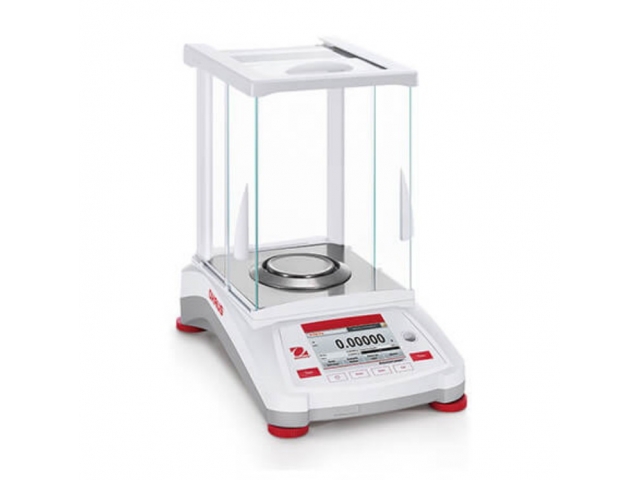
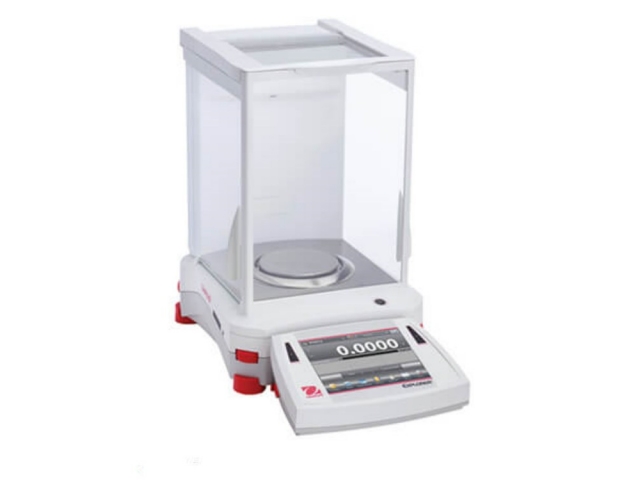
The structural design details of analytical balances are closely matched with their precision performance, and every component optimization is aimed at eliminating interference and improving accuracy. The closed draft shield structure is a standard configuration for all analytical balances, composed of fully enclosed transparent glass baffles, which can completely isolate the interference of indoor air convection, breathing wind, and slight air flow on tiny sample weighing, solving the problem of data jitter caused by air flow in open weighing equipment. The weighing pan adopts a suspended independent structural design, which avoids the conduction of external vibration and shell stress to the sensing core, ensuring the independence of the weighing force transmission process. The internal sensor adopts a monolithic integrated structure, which reduces the structural gaps and assembly errors of traditional combined components, and improves the overall structural stability and force transmission accuracy. The digital display system adopts high-definition LCD or touch screen design, with clear and intuitive data display, and supports multi-unit conversion, statistical data display, and real-time error prompt functions. The bottom of the instrument is equipped with adjustable horizontal foot pads and a high-precision horizontal bubble device, which can adjust the horizontal state of the instrument in real time to avoid weighing deviation caused by placement tilt, providing basic guarantee for horizontal stress balance during weighing.
In terms of functional design, modern analytical balances integrate a variety of intelligent auxiliary functions to meet the diversified needs of laboratory precision experiments. The automatic tare function is the most basic practical function, which can quickly zero the weight of sample containers such as weighing bottles and culture dishes, directly obtaining the net mass of the sample and simplifying the experimental operation process. The automatic calibration function includes internal automatic timing calibration and external manual calibration. The internal calibration system can automatically complete parameter correction according to temperature changes and working hours, eliminating system drift errors; external calibration meets the precision correction needs after long-term use and mobile placement of the equipment. The data statistics function can automatically record multiple weighing data, calculate the average value, maximum and minimum values, and standard deviation, which is convenient for experimental personnel to analyze data repeatability and experimental error. In addition, the equipment is equipped with anti-overload protection function, which can automatically sense overload state and protect the internal precision sensor from damage; the anti-static and dust-proof design can reduce the adsorption of tiny dust and static electricity on ultra-fine samples, further improving the accuracy of trace sample weighing.
The daily application and maintenance characteristics of analytical balances determine their long-term use stability and service life, and their structural and parameter design fully considers the adaptability of laboratory daily use scenarios. Compared with traditional mechanical analytical balances that require manual balancing and repeated debugging, modern electronic analytical balances have simple operation procedures, low operation threshold, and do not require professional debugging skills, which can be quickly operated by experimental personnel after simple training. The equipment has strong environmental adaptability, and through built-in temperature and vibration compensation algorithms, it can resist slight environmental changes in conventional laboratories, without requiring extremely harsh constant temperature and vibration isolation conditions, reducing the use threshold and maintenance cost. In terms of daily maintenance, the smooth stainless steel weighing pan and fully enclosed glass structure are convenient for daily cleaning and decontamination, effectively avoiding the impact of reagent residue and dust accumulation on weighing accuracy. The long-term stable sensor and circuit system can maintain consistent precision performance for a long time, avoiding frequent precision attenuation and component replacement problems, and reducing the comprehensive use cost of laboratory precision weighing equipment.
With the continuous progress of laboratory analysis technology, the technical iteration and performance optimization of analytical balances are still ongoing, and the development trend of high precision, intelligence, integration, and environmental adaptation is becoming increasingly obvious. On the basis of maintaining ultra-high weighing accuracy, new-generation analytical balances are optimizing structural miniaturization, reducing equipment volume while improving space utilization, adapting to the compact layout of modern integrated laboratories. Intelligent functions are further enriched, realizing automatic sample weighing, remote data monitoring, and intelligent error diagnosis, which greatly improves the automation level of laboratory experimental analysis. At the same time, the material technology is continuously upgraded, adopting more corrosion-resistant, anti-static, and temperature-stable new composite materials to further enhance the equipment's environmental adaptability and service life. As the core basic equipment of precision analysis, analytical balances will continue to support the innovative development of chemical analysis, pharmaceutical research, material science, and environmental detection fields, providing accurate and reliable basic data support for scientific research innovation and industrial quality upgrading.
