





Changzhou Veidt Weighing Co., Ltd. © 2022 ALL RIGHTS RESERVED Privacy Policy | Calibration Weight | Test Weights | Cast Iron Weights | Standard Weights | Laboratory Weights | XML | SITEMAP
NEWS LIST
F1 Calibration Weights
Saturday 26th September 2026 Back to list
F1 calibration weights stand as indispensable precision instruments in the field of metrology, serving as critical reference tools for accurate mass measurement and instrument calibration across laboratory, industrial, and research scenarios. Falling into the high-precision category of standard weighing masses, these calibration weights are engineered to deliver exceptional measurement stability and minimal error, bridging the gap between ultra-high-level reference standards and conventional precision weighing equipment. Unlike ordinary weighing weights, F1 calibration weights feature rigorous manufacturing craftsmanship, stable physical properties, and strict error control, making them suitable for calibrating high-resolution analytical balances, precision scales, and verifying lower-grade calibration weights. They underpin the accuracy, consistency, and traceability of mass measurement data in numerous professional fields, from pharmaceutical testing and chemical analysis to food quality inspection and scientific research experiments, ensuring all weighing operations comply with precision measurement requirements and eliminating systematic errors caused by instrument drift or environmental interference.
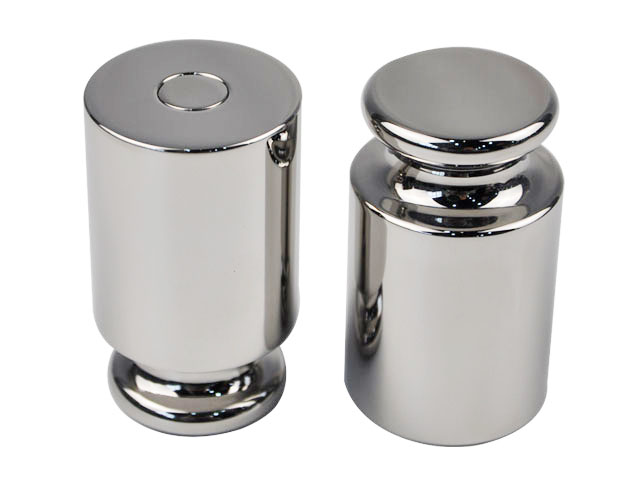
The core value of F1 calibration weights lies in their superior material composition and refined manufacturing technology, which lay a solid foundation for long-term stable and accurate measurement performance. Most high-quality F1 calibration weights are crafted from premium non-magnetic stainless steel materials, selected for their excellent resistance to oxidation, corrosion, and physical deformation. This specialized material effectively avoids mass changes caused by air oxidation, moisture erosion, or chemical contact in complex laboratory and industrial environments, maintaining consistent mass parameters throughout long-term use. During production, each weight undergoes precise machining, surface polishing, and fine mass adjustment processes, with every detail refined to eliminate microscopic defects that may affect measurement accuracy. Additionally, the structural design of F1 calibration weights is optimized for uniform stress distribution, preventing slight mass deviation caused by extrusion, collision, or long-term placement. Such rigorous production standards enable these weights to maintain ultra-low measurement uncertainty, allowing them to serve as reliable benchmark references for daily calibration and periodic verification of precision weighing instruments.
F1 calibration weights occupy a unique and irreplaceable position in the hierarchical system of mass measurement calibration, with clear application positioning that distinguishes them from higher and lower precision weight grades. As a mid-to-high precision calibration tool, they are perfectly suited for routine calibration and daily inspection of high-precision laboratory balances, including analytical balances and semi-micro balances that require extremely high reading accuracy. In professional metrology work, F1 calibration weights act as a key transfer medium, capable of calibrating and verifying common precision weighing weights of lower accuracy levels, realizing the downward transmission of standard mass values. Compared with ultra-high precision reference weights that are only used in professional metrology laboratories, F1 calibration weights have stronger environmental adaptability and practical operability, supporting frequent use in conventional laboratory and industrial quality control scenarios. Meanwhile, they offer higher accuracy and stability than ordinary industrial calibration weights, effectively meeting the strict measurement demands of industries that require precise data support, avoiding measurement errors that may lead to experimental failure or product quality deviation.
Scientific application and standardized operation of F1 calibration weights are essential to maximize their measurement accuracy and extend their service life. Before each calibration operation, users need to place the F1 calibration weights in the working environment for a period of temperature adaptation to eliminate mass changes caused by temperature difference between the weights and the operating space, as temperature fluctuation is one of the main factors affecting weighing accuracy. During use, it is strictly prohibited to directly touch the weight surface with hands, as sweat, oil stains, and dust on the skin will adhere to the surface, causing subtle mass changes and contaminating the precision surface. Special tweezers or weight taking tools are required to handle the weights to ensure surface cleanliness and structural integrity. In the calibration process, operators need to place the weights stably on the center of the weighing instrument’s pan, avoid vibration and airflow interference in the surrounding environment, and complete the weighing test in a stable state. Standardized operation not only ensures the authenticity and validity of each calibration result but also prevents artificial damage to the weights, maintaining their long-term measurement stability.
Reasonable storage and regular maintenance are crucial for sustaining the long-term performance of F1 calibration weights, as their precision performance is highly sensitive to storage conditions and daily maintenance status. These calibration weights need to be stored in a dry, clean, constant-temperature storage box equipped with shockproof and dustproof structures, which can effectively isolate external dust, moisture, and mechanical vibration interference. Humid and corrosive environments must be avoided to prevent surface rust, oxidation, or chemical corrosion that may alter the standard mass. After each use, the weights should be gently wiped with a professional clean soft cloth to remove tiny dust and residual stains on the surface, then placed back in the fixed position of the storage box to avoid collision and extrusion between weights. In addition, regular professional inspection and maintenance are required, including surface integrity check and mass error detection, to timely identify subtle mass deviation or surface damage. Scientific maintenance can greatly extend the service cycle of F1 calibration weights and ensure that their accuracy remains consistent in long-term repeated use.
F1 calibration weights are widely applied in multiple high-precision industries and scientific research fields, providing core guarantee for standardized measurement and quality control. In pharmaceutical laboratories, they are used for calibrating precision weighing instruments used in drug ingredient testing, sample preparation, and reagent configuration, ensuring accurate drug ratio and reliable test data, which is closely related to drug safety and quality stability. In chemical analysis experiments, these weights assist in calibrating analytical balances for preparing standard solutions and detecting chemical sample components, effectively reducing experimental measurement errors and improving the repeatability and credibility of experimental results. In the food processing and testing industry, F1 calibration weights support the precision detection of food additives, nutritional components, and product net content, helping enterprises meet quality control requirements and ensure product compliance. Moreover, they are also commonly used in environmental monitoring, material science research, and academic laboratory teaching, becoming a basic precision tool for supporting various professional measurement work.
The advantages of F1 calibration weights in practical application are fully reflected in their balance of precision, stability, and applicability, making them the preferred choice for most precision weighing calibration scenarios. In terms of precision, they can meet the calibration requirements of high-resolution weighing instruments, with extremely small allowable error range, which can capture subtle measurement changes that ordinary weights cannot identify. In terms of stability, the high-quality material and fine processing technology enable the weights to resist external environmental interference, with no obvious mass attenuation or accuracy drift after long-term use. In terms of applicability, they are not limited to professional metrology laboratories, but can adapt to daily calibration work in conventional laboratories and industrial production links, with simple and efficient operation procedures and strong practicability. Compared with higher-level ultra-precision weights that are expensive and not suitable for frequent use, F1 calibration weights have higher cost performance and practical value, perfectly matching the daily precision measurement needs of most institutions and enterprises.
In the modern precision manufacturing and scientific research system, F1 calibration weights play a vital foundational role in unifying measurement standards and improving the overall level of precision detection. All precision weighing data involved in industrial quality inspection, scientific research experiments, and commercial detection need to be traced back to standard mass references, and F1 calibration weights undertake the important task of converting and transmitting standard mass values in intermediate links. Their stable and accurate performance ensures the consistency of weighing data in different time periods, different equipment, and different detection scenarios, avoiding measurement deviation caused by inconsistent instrument accuracy. With the continuous improvement of industrial precision production standards and scientific research accuracy requirements, the demand for high-stability calibration tools is increasing day by day. As a mature and reliable high-precision calibration tool, F1 calibration weights will continue to provide solid technical support for standardized measurement work in various fields and promote the continuous improvement of precision measurement levels in all walks of life.
