





Changzhou Veidt Weighing Co., Ltd. © 2022 ALL RIGHTS RESERVED Privacy Policy | Calibration Weight | Test Weights | Cast Iron Weights | Standard Weights | Laboratory Weights | XML | SITEMAP
NEWS LIST
M1 Calibration Weight Set
Saturday 26th September 2026 Back to list
The M1 calibration weight set serves as a fundamental and versatile measuring tool widely applied in daily weighing verification, routine instrument calibration, and general industrial and commercial weighing scenarios. Designed to deliver reliable medium-level measurement accuracy, this weight set strikes an optimal balance between precision stability and practical applicability, making it suitable for most conventional weighing equipment calibration needs. It features a complete combination of weight specifications, stable physical properties, and strong environmental adaptability, which allows it to maintain consistent mass accuracy in regular working environments. Unlike high-precision weight tools dedicated to extreme laboratory scenarios, the M1 calibration weight set focuses on meeting daily standardized weighing verification requirements, effectively correcting measurement deviations of various scales and balances. Its durable structure and convenient operation also reduce the threshold of daily calibration work, helping industries and commercial sectors standardize weighing processes, avoid measurement errors caused by instrument drift, and ensure the fairness and accuracy of daily weighing operations throughout various application scenarios.
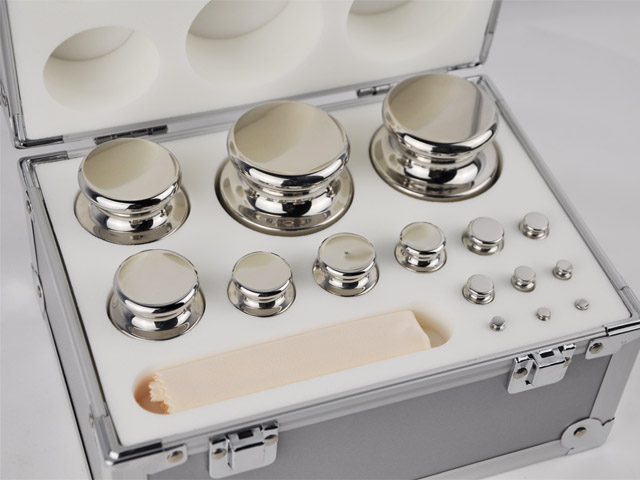
Material selection is the core foundation that supports the stable performance of the M1 calibration weight set, directly determining its service life, accuracy retention and environmental adaptability. Most conventional M1 calibration weight sets adopt high-quality cast iron or refined stainless steel as the main raw materials, two materials with unique advantages to adapt to different use and storage environments. Cast iron-based weight sets feature high overall density and excellent structural stability, with uniform internal texture that is not prone to deformation under conventional external force extrusion, ensuring long-term mass stability in frequent use scenarios. Stainless steel versions are processed with fine polishing and anti-corrosion treatment on the surface, effectively resisting oxidation, moisture and minor chemical erosion in daily working environments, which is more suitable for humid workshops, open commercial spaces and other environments with relatively complex conditions. Both materials undergo strict forging and finishing processes, with smooth and burr-free surfaces that prevent residual dust and dirt from affecting weighing accuracy. The integrated molding process eliminates internal gaps and structural defects, ensuring that each weight can maintain consistent mass performance during long-term repeated calibration operations.
The M1 calibration weight set is equipped with a complete and reasonable specification combination, covering multiple mass ranges to meet diversified calibration demands of different weighing equipment. The complete set usually includes small gram-level weights and large kilogram-level weights, forming a gradient mass system that can adapt to the calibration and verification of small precision bench scales and large-scale platform scales. Each single weight in the set is independently processed and screened, with uniform specification standards and stable mass values, which can be used alone or in combination according to actual calibration needs. This flexible collocation mode greatly improves the applicability of the weight set, avoiding the limitation of single specification tools that can only adapt to fixed equipment. In daily use, operators can combine weights of different specifications to complete full-range calibration of weighing instruments, effectively detecting measurement deviations in different weight intervals. The standardized size design of each weight also ensures convenient stacking, placement and storage, avoiding position offset and mass change caused by irregular placement, and further optimizing the overall calibration operation efficiency.
As a medium-precision calibration tool, the M1 calibration weight set has extremely outstanding practical value in commercial weighing scenarios. In daily commodity trading, retail weighing, bulk goods measurement and other links, accurate weighing results are the core guarantee of transaction fairness, and regular calibration of weighing equipment with M1 weight sets can effectively eliminate systematic errors of instruments. Long-term use of weighing equipment is prone to zero drift, sensor aging and mechanical wear, which will lead to gradual deviation of measurement data. Regular calibration with M1 calibration weights can timely detect and correct these deviations, ensuring that the weighing data of commercial equipment is always within the reliable error range. It is widely used in market retail, grain measurement, logistics weighing and other commercial fields, solving the problem of inaccurate weighing caused by uncalibrated instruments. Its moderate precision performance fully matches the accuracy requirements of commercial weighing scenarios, avoiding the waste of high-precision resources while ensuring transaction standardization, and becoming an essential standard tool for commercial weighing management.
In general industrial production and processing fields, the M1 calibration weight set undertakes the important task of routine equipment maintenance and weighing standardization. Industrial production involves a large number of links such as raw material batching, finished product weighing and workshop material statistics, all of which rely on stable and accurate weighing data to ensure production consistency and product quality. Most industrial weighing equipment such as bench scales, platform scales and hanging scales are suitable for calibration with M1 weight sets, which can meet the precision requirements of industrial conventional weighing. In the daily production process, enterprises can use the weight set for regular spot checks and regular calibration of weighing equipment, timely eliminate measurement errors caused by equipment vibration, environmental temperature change and long-term operation. This regular calibration work can effectively stabilize production batching accuracy, reduce product quality fluctuations caused by inaccurate weighing, and improve the overall qualification rate of products. At the same time, the durable and wear-resistant characteristics of the M1 calibration weight set adapt to the frequent use environment of industrial workshops, with lower maintenance cost and longer service cycle.
The M1 calibration weight set also plays an indispensable auxiliary role in conventional laboratory teaching and basic experimental research. Many basic physics experiments, measurement teaching demonstrations and routine experimental verification in teaching laboratories do not require ultra-high precision measurement standards, and the medium-precision M1 weight set can fully meet the experimental and teaching needs. It provides standardized mass references for students to understand weighing principles, master instrument calibration methods and practice measurement operations, helping learners establish correct cognition of measurement accuracy and error control. In basic scientific research experiments that do not involve ultra-precision measurement, researchers can use the M1 weight set to calibrate conventional experimental weighing instruments, ensuring the basic accuracy of experimental data and improving the authenticity and repeatability of experimental results. The simple operation and stable performance of the weight set reduce the difficulty of experimental preparation and teaching demonstration, making it a common supporting tool for school laboratories and grassroots scientific research institutions.
Standardized daily maintenance and scientific storage methods are key to maintaining the long-term accuracy and service life of the M1 calibration weight set. Although the weight set has good structural stability and environmental adaptability, improper use and storage will still cause mass deviation and surface damage. In daily operation, weights should be handled gently to avoid violent collision, drop and friction with hard objects, so as to prevent surface wear and internal structural deformation that affect mass accuracy. Operators should avoid directly touching the weight surface with hands, as sweat and grease will adhere to the surface, causing oxidation and dirt accumulation and changing the actual mass of the weights. After each use, the weights need to be cleaned with a dry soft cloth to remove surface dust and stains, and then placed in a matched special storage box. The storage box has a shockproof and moisture-proof design, which can isolate humid air, dust and external vibration interference, and keep the weights in a stable storage environment. Regular manual inspection is also required to check for surface oxidation, deformation and specification loss, ensuring that the weight set is always in a usable state.
Compared with high-precision professional weight sets and ordinary low-precision weighing tools, the M1 calibration weight set has unique comprehensive advantages in applicability and cost performance. High-precision calibration weight sets are mostly used in professional precision laboratories and special detection scenarios, with high use and maintenance thresholds, and are not suitable for daily frequent calibration work. Ordinary low-precision weighing tools have large error ranges and poor stability, which cannot meet the standardized weighing verification needs of commerce and industry. The M1 calibration weight set perfectly fills the gap between the two, with moderate precision that fully meets the accuracy requirements of most conventional weighing scenarios, and has lower use and maintenance costs. Its strong environmental adaptability and durable structural design enable it to adapt to various complex working environments, avoiding frequent replacement and repeated calibration of tools. In addition, the complete specification matching and flexible use mode greatly improve the work efficiency of weighing instrument calibration, providing a stable and reliable standard guarantee for the standardized operation of commercial transactions, industrial production and basic measurement work.
