





Changzhou Veidt Weighing Co., Ltd. © 2022 ALL RIGHTS RESERVED Privacy Policy | Calibration Weight | Test Weights | Cast Iron Weights | Standard Weights | Laboratory Weights | XML | SITEMAP
Product Category
Veidt Weighing is a Spring Balance factory in china. In the realm of mechanical engineering and everyday utility, the concept of “Spring Balance” stands as a testament to the elegant simplicity of mechanical principles and their profound impact on human productivity and innovation. Spring balance, at its core, refers to the use of elastic springs to measure force, weight, or to maintain equilibrium in a wide range of systems—from the humble household weighing scale to complex industrial machinery. For centuries, this principle has been harnessed to bridge the gap between theoretical mechanics and practical application, enabling precise measurements, efficient energy transfer, and enhanced operational stability. As technology advances and industries evolve, the role of spring balance continues to expand, adapting to new challenges and requirements while retaining its fundamental purpose: to balance forces and deliver reliable performance. In an era marked by the demand for precision manufacturing, sustainable engineering, and seamless automation, understanding the nuances of spring balance—its working principles, diverse applications, technological advancements, and future potential—becomes increasingly important.
At the heart of spring balance lies Hooke’s Law, a fundamental principle of physics that states that the force exerted by a spring is directly proportional to the displacement it undergoes from its equilibrium position. Mathematically expressed as F = -kx (where F is the force, k is the spring constant, and x is the displacement), this law provides the theoretical foundation for all spring balance systems. When a force—such as the weight of an object—is applied to a spring, the spring stretches or compresses, and the extent of this deformation corresponds directly to the magnitude of the applied force. By calibrating the spring to known forces, it becomes possible to measure unknown forces with a high degree of accuracy. This simplicity is one of the key strengths of spring balance, as it allows for the creation of compact, cost-effective devices that require minimal maintenance and can operate in a wide range of environmental conditions.
However, the practical implementation of spring balance is not without its complexities. The performance of a spring balance system depends heavily on the properties of the spring itself, including its material composition, design, and manufacturing quality. The spring constant (k) must be carefully selected to match the intended application—too stiff, and the spring will not deform sufficiently to provide measurable displacement; too weak, and it may undergo permanent deformation under the applied force. Additionally, factors such as temperature fluctuations, wear and tear, and fatigue can affect the elasticity of the spring over time, compromising the accuracy of the balance system. To address these challenges, engineers must carefully design and test spring balance systems, selecting materials that offer high elasticity, durability, and resistance to environmental factors. Common materials used in spring manufacturing include high-carbon steel, stainless steel, and various alloys, each chosen for their specific mechanical properties and suitability for different applications.
The applications of spring balance are diverse and span across numerous industries, reflecting its versatility and practical utility. One of the most familiar uses is in mechanical weighing scales, which have been a staple in households, markets, and laboratories for generations. These scales use a spring to counteract the weight of the object being measured, with a pointer or digital display indicating the corresponding force. Unlike electronic scales, which rely on sensors and power sources, spring balance scales are portable, reliable, and can be used in areas where electricity is unavailable—making them essential in rural communities and fieldwork settings.
Beyond weighing, spring balance plays a critical role in industrial machinery and equipment. In manufacturing processes, spring balance systems are used to control tension in conveyor belts, ensuring that materials are transported smoothly and efficiently without slipping or damaging the belt. They are also employed in assembly lines to provide consistent pressure during joining, welding, or fastening operations, ensuring the quality and uniformity of the final product. In the automotive industry, spring balance principles are integral to suspension systems, which use springs to absorb shocks and vibrations from the road, improving ride comfort and vehicle stability. The springs in these systems must balance the weight of the vehicle with the forces encountered during driving, requiring precise engineering to ensure optimal performance and safety.
The aerospace and aviation sectors also rely heavily on spring balance technology. In aircraft, spring balance systems are used in control surfaces such as ailerons, elevators, and rudders to provide the necessary resistance and feedback to pilots. These systems ensure that the control surfaces respond predictably to the pilot’s inputs, even under the extreme conditions of high altitude and speed. Additionally, spring balance is used in cargo loading systems to distribute weight evenly, ensuring the aircraft’s balance and stability during flight. The precision and reliability of these systems are paramount, as any failure could have catastrophic consequences—highlighting the critical role of spring balance in ensuring safety in high-risk industries.
Another important application of spring balance is in the field of medical equipment. In devices such as dialysis machines, spring balance systems are used to control fluid flow and pressure, ensuring that the treatment is delivered safely and effectively. They are also employed in prosthetic limbs to provide natural movement and support, mimicking the elasticity of human muscles and tendons. The ability of spring balance systems to deliver consistent, controlled forces makes them ideal for medical applications, where precision and patient safety are of utmost importance.
As technology evolves, the design and implementation of spring balance systems have undergone significant advancements, enhancing their performance, accuracy, and versatility. One of the key developments is the integration of spring balance with digital technology, creating hybrid systems that combine the reliability of mechanical springs with the precision and convenience of digital measurement. These systems use sensors to detect spring displacement, converting the mechanical signal into a digital readout that can be easily recorded, analyzed, and transmitted. This integration has expanded the capabilities of spring balance systems, allowing for real-time monitoring and data collection—essential in modern manufacturing and industrial processes where quality control and process optimization are critical.
Advancements in materials science have also contributed to the evolution of spring balance. The development of new alloys and composite materials has enabled the creation of springs that are lighter, stronger, and more resistant to fatigue and environmental factors. For example, titanium alloys are now used in springs for aerospace and medical applications, as they offer high strength-to-weight ratios and excellent corrosion resistance. Carbon fiber composites are another innovative material, providing superior elasticity and durability while reducing the overall weight of the spring system. These material advancements have not only improved the performance of spring balance systems but also expanded their use in applications where weight and space are limited, such as in miniaturized electronic devices and unmanned aerial vehicles (UAVs).
The trend toward sustainability and energy efficiency has also influenced the development of spring balance technology. In many industrial processes, spring balance systems are used to optimize energy consumption by reducing friction and minimizing energy loss. For example, in conveyor systems, properly calibrated spring balance reduces the amount of power required to move materials, lowering energy costs and reducing the carbon footprint of the operation. Additionally, the durability and long lifespan of modern spring materials reduce the need for frequent replacement, minimizing waste and contributing to a more sustainable manufacturing model. As industries strive to meet global sustainability goals, spring balance technology is increasingly being recognized as a valuable tool for reducing environmental impact while maintaining operational efficiency.
Despite its many advantages, spring balance technology faces several challenges that must be addressed to unlock its full potential. One of the main limitations is the issue of spring fatigue, which occurs when a spring is subjected to repeated cycles of deformation, leading to a gradual loss of elasticity and eventual failure. This is a particular concern in high-cycle applications such as industrial machinery and automotive suspension systems, where springs are subjected to constant stress. To mitigate this, engineers are developing new spring designs and materials that offer improved fatigue resistance, as well as implementing predictive maintenance strategies that use sensor data to monitor spring performance and identify potential failures before they occur.
Another challenge is the need for higher precision in increasingly demanding applications. As industries such as microelectronics and biotechnology push the boundaries of miniaturization, the requirements for spring balance systems have become more stringent, with tolerances measured in micrometers. To meet these demands, manufacturers are using advanced manufacturing techniques such as 3D printing and precision machining to create springs with complex geometries and ultra-high precision. These techniques allow for greater control over the spring’s properties, ensuring that it meets the exact specifications of the application.
The future of spring balance technology looks promising, with new applications and innovations emerging as industries continue to evolve. One area of growth is in the field of robotics, where spring balance systems are being used to create more agile and energy-efficient robots. By incorporating springs into the robot’s joints and limbs, engineers can reduce the amount of power required to move the robot, allowing for longer battery life and more natural movement. This is particularly important in applications such as search and rescue, where robots need to operate for extended periods in remote areas without access to power sources.
The renewable energy sector also presents significant opportunities for spring balance technology. In wind turbines, for example, spring balance systems can be used to control the pitch of the blades, optimizing their angle to capture maximum wind energy while protecting the turbine from damage during high winds. Similarly, in solar panel systems, spring balance can be used to adjust the orientation of the panels, ensuring that they receive maximum sunlight throughout the day. These applications not only improve the efficiency of renewable energy systems but also contribute to the global transition toward cleaner, more sustainable energy sources.
Additionally, the integration of spring balance with artificial intelligence (AI) and machine learning is expected to revolutionize the way these systems are designed and operated. AI algorithms can analyze large amounts of sensor data from spring balance systems, identifying patterns and optimizing performance in real time. For example, in manufacturing processes, AI can adjust the spring tension in conveyor belts to adapt to changes in material weight or speed, ensuring consistent performance and reducing waste. This level of automation and optimization will make spring balance systems more efficient, reliable, and adaptable to changing conditions.
Education and knowledge sharing are also critical to the continued advancement of spring balance technology. As new materials, designs, and applications emerge, it is essential for engineers, manufacturers, and students to stay updated on the latest developments. Academic institutions and industry organizations play a key role in this, offering training programs, research opportunities, and collaborative projects that foster innovation and knowledge exchange. By investing in education and research, the industry can ensure that spring balance technology continues to evolve and meet the needs of future generations.
In conclusion, spring balance is a fundamental mechanical principle that has played a vital role in human progress for centuries. From simple weighing scales to complex aerospace systems, its applications are diverse and far-reaching, reflecting its versatility and practical utility. As technology advances, spring balance systems continue to evolve, incorporating new materials, digital integration, and sustainable design principles to meet the changing needs of industries and society. While challenges such as spring fatigue and precision requirements remain, ongoing innovations in materials science, manufacturing, and automation are paving the way for new applications and improved performance. The future of spring balance technology is bright, with the potential to contribute to sustainable development, technological innovation, and improved quality of life. As we continue to explore the possibilities of this timeless principle, it is clear that spring balance will remain a cornerstone of mechanical engineering and practical innovation for years to come.
Learn more about digital spring balance, mechanical spring balance, portable spring balance, spring balance scale, spring balance calibration, high precision spring balance, spring balance weight, laboratory spring balance, spring balance accuracy, industrial spring balance, spring balance for weighing, spring balance sensitivity, spring balance tolerance, spring balance specification, spring balance maintenance, spring balance verification, hanging spring balance, spring balance calibration weight, spring balance for teaching, spring balance accessories, spring balance calibration procedure, spring balance error, spring balance for lifting, spring balance user manual, spring balance price, spring balance parts, spring balance calibration standard, spring balance for tension measurement, spring balance calibration certificate, spring balance for industrial use, spring balance traceability, spring balance calibration service, spring balance for fish weighing, spring balance calibration frequency, spring balance for laboratory experiments, spring balance calibration method, spring balance for agriculture, spring balance calibration kit, spring balance for construction, spring balance calibration check, spring balance repeatability test, spring balance for warehouse, spring balance calibration record, spring balance anti-rust coating, spring balance for quality control, spring balance for textile industry, spring balance linear calibration, spring balance for food processing, spring balance calibration verification standard, pls contact us.
A spring balance, also widely referred to as a spring scale in daily and industrial scenarios, is a classic mechanical measuring instrument that has stood the test of time in the field of force and weight measurement. Unlike complex electronic weighing devices that rely on circuit boards, sensors and digital display modules, the spring balance operates on a pure physical mechanism, making it one of the most accessible and widely used measuring tools across educational, household, industrial and field work settings. Its core design draws on the fundamental laws of elasticity in physics, and its simple structure, stable performance and easy operation have made it an indispensable item in classrooms, workshops, warehouses and outdoor workstations for generations. From middle school physics laboratories where students first learn about force and gravity, to small retail stores checking the weight of goods, to construction sites measuring the tension of ropes and cables, the spring balance appears in countless corners of daily life and production, quietly fulfilling its measuring role without relying on complex power sources or sophisticated calibration equipment. What makes it so enduring is not only its practicality but also its ability to intuitively present abstract physical concepts, turning invisible force into visible, readable data through simple mechanical deformation.
To fully understand the working logic of a spring balance, one must first delve into the basic physical principle that underpins its entire design: Hooke's Law, a foundational rule in the study of elastic materials. Discovered and summarized by British scientist Robert Hooke, this law states that within the elastic limit of an elastic object, the deformation or displacement of the object is directly proportional to the external force applied to it. For the spring inside a spring balance, this means that when a tensile or compressive force acts on the spiral spring, the spring will stretch or compress evenly, and the length of this deformation corresponds steadily to the magnitude of the force. Once the external force is removed, the spring can return to its original length and shape, provided the force does not exceed its elastic limit; exceeding this limit will cause permanent deformation, rendering the spring balance inaccurate and unusable. This reversible elastic deformation is the key to the spring balance’s function. The entire measuring process follows a fixed and reliable path: an external force acts on the measuring end of the device, the spring undergoes controlled elastic deformation, this deformation is transmitted to a pointer or indicator through a simple mechanical structure, and the pointer moves along a calibrated scale to display the corresponding force or weight value. This direct conversion between mechanical deformation and numerical reading eliminates intermediate electronic conversion links, reducing the chance of failure and ensuring stable measurement results in various environments.
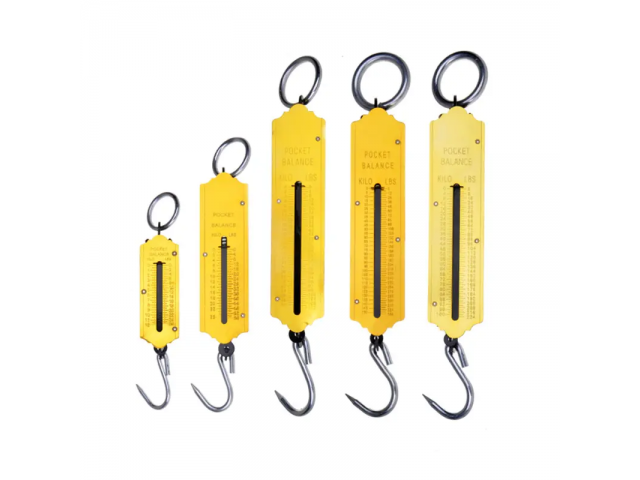
The structural composition of a standard spring balance is remarkably simple, with every component serving a clear and necessary purpose, and there are no redundant parts that complicate its operation. Typically, a complete spring balance consists of several core parts: a fixed housing or frame, a precision-made spiral elastic spring, a measuring hook, a pointer assembly, a graduated scale plate, and a top lifting ring or fixed base. The housing, usually made of durable plastic or lightweight metal, acts as a protective shell, shielding the internal spring and mechanical parts from dust, moisture, accidental collisions and external interference, while also providing a stable mounting surface for the scale plate and pointer. The spiral spring is the heart of the entire device; its material, wire diameter, coil density and length are all carefully calculated and processed to ensure consistent elastic performance within the designed measuring range. High-quality springs are made from alloy steel with excellent elasticity and fatigue resistance, capable of withstanding repeated stretching and compression without losing their elastic properties over long periods of use. The measuring hook, located at the bottom of the spring, is used to hang the object to be weighed or apply the tensile force to be measured, and it is designed to be sturdy and smooth to prevent damage to the measured object or accidental slipping during use. The pointer, a thin and lightweight metal or plastic strip, is firmly connected to the lower end of the spring, moving vertically or horizontally along the scale plate as the spring deforms. The scale plate is marked with clear, uniform graduation lines, with corresponding numerical values indicating the magnitude of force or weight; common units include Newtons for force measurement and grams or kilograms for weight measurement, catering to different measuring needs. The top lifting ring provides a convenient way to hold or fix the spring balance, ensuring it remains in a stable vertical position during measurement, which is critical for obtaining accurate readings.
The operation of a spring balance is designed to be intuitive and user-friendly, requiring no specialized technical training for basic use, though following correct operating steps is essential to ensure measurement accuracy and prolong the device’s service life. Before starting any measurement, the first step is to conduct a zero-check: hold the spring balance vertically by the lifting ring, and observe whether the pointer aligns perfectly with the zero graduation line on the scale plate. If the pointer deviates from the zero mark, a small adjustment knob, usually located at the top of the housing near the spring’s fixed end, can be used to reposition the pointer to zero. This zero-calibration step is often overlooked by casual users, but it is vital to eliminate initial errors caused by transportation, long-term storage or slight mechanical shifts. Next, users must confirm the measuring range and graduation value of the spring balance: the measuring range refers to the maximum force or weight the device can accurately measure, and exceeding this range will damage the spring’s elasticity; the graduation value refers to the actual force or weight represented by each small graduation on the scale plate, which determines the precision of the measurement. After completing these preparatory steps, the object to be measured can be gently hung on the bottom hook, ensuring the object hangs freely without touching the housing or any other external objects, and that the pulling force is strictly along the vertical central axis of the spring to avoid lateral friction that would skew the readings. Once the object is stable and the pointer stops moving, the user should keep their line of sight perpendicular to the scale plate to read the value, as viewing from an angle will create parallax errors and lead to inaccurate results. For compressive spring balances, which are designed to measure downward pressure rather than tensile force, the operation involves applying steady, vertical pressure to the measuring platform instead of hanging an object, following the same principles of alignment and stable reading.
Spring balances are divided into different types based on their design purpose, measuring range and application scenarios, each tailored to meet specific measuring needs in different fields. The most common classification is based on the direction of force measurement: tensile spring balances, which are used to measure pulling force and the weight of suspended objects, and compressive spring balances, which are used to measure downward pressure and the weight of objects placed on a platform. Tensile spring balances are more prevalent in daily life, coming in various sizes from small portable models with a narrow measuring range for household use to large, heavy-duty models with a wide measuring range for industrial and agricultural applications. Portable small spring balances are lightweight and compact, easy to carry in a bag or pocket, often used for daily tasks such as checking the weight of groceries, measuring small tools or weighing luggage during travel; they have a relatively small measuring range, suitable for light objects. Medium-sized spring balances are commonly used in classrooms and small workshops, with a moderate measuring range and higher precision, ideal for physics experiments, manual processing and small-batch goods weighing. Heavy-duty industrial spring balances are built with thicker, stronger springs and reinforced housings, capable of measuring larger forces and heavier weights, widely used in construction, agriculture, logistics and manufacturing, such as measuring the tension of steel cables, weighing agricultural products, checking the load of small packages and testing the pulling force of mechanical parts. In addition to this classification, spring balances can also be divided into standard precision models for laboratory use and general-purpose models for daily and industrial use, with laboratory models featuring finer graduation lines and more strictly calibrated springs to meet the higher accuracy requirements of scientific experiments and data recording.
Beyond daily and industrial measurement, spring balances play an irreplaceable role in physics education and scientific research, serving as a vital tool for teaching and verifying basic mechanical principles. In primary and secondary school physics classrooms, spring balances are the first instrument students use to come into contact with the concepts of force, gravity, mass and elastic deformation. Through hands-on operation, students can directly observe how the spring stretches as the weight of the hung object increases, visually verifying the proportional relationship between external force and spring deformation described by Hooke's Law. Teachers can design simple experiments using spring balances to help students distinguish between mass and weight, two easily confused physical concepts: mass is the amount of matter in an object, a constant physical quantity regardless of location, while weight is the gravitational force exerted on an object by the Earth, which varies slightly with geographical location. Students can also use spring balances to conduct experiments on buoyancy, measuring the apparent weight of objects submerged in different liquids to calculate buoyant force, deepening their understanding of Archimedes' principle. In college basic physics laboratories, spring balances are still used in introductory mechanics experiments, especially in teaching scenarios where intuitive physical phenomena are prioritized over high-precision digital data. They help students establish a solid foundation in mechanical measurement, training them to master basic experimental skills such as zero calibration, error control and accurate reading, which are essential for more advanced scientific research and engineering practice. Unlike high-precision electronic sensors, spring balances allow students to observe the entire physical process of force conversion, making abstract mechanical theories tangible and easier to comprehend.
While spring balances are known for their sturdy and durable structure, proper daily maintenance and correct usage habits are crucial to maintaining their measurement accuracy and extending their service life, preventing unnecessary damage and performance degradation. One of the most important maintenance rules is to never exceed the designed measuring range during use, as repeated overloading or a single severe overload will cause the spring to exceed its elastic limit, resulting in permanent plastic deformation that cannot be reversed. Once the spring loses its original elasticity, the pointer will no longer return to the zero mark, and the readings will be consistently inaccurate, making the device unusable. In daily storage, spring balances should be placed in a dry, ventilated environment away from moisture, corrosive gases, high temperatures and direct sunlight. Humid environments can cause the metal spring and metal components to rust, reducing elasticity and increasing mechanical friction between the pointer and scale plate; corrosive substances can damage the surface of the housing and the internal structure, while extreme temperatures can affect the elastic properties of the spring material. After each use, any dirt, dust or liquid residue on the hook, housing and scale plate should be gently wiped clean with a soft, dry cloth; abrasive cleaners or harsh chemicals should be avoided to prevent scratching the scale plate or corroding the components. When not in use for long periods, the spring balance should be stored in a relaxed state, with no weight hung on the hook, to prevent the spring from being in a sustained stretched state that leads to fatigue and loss of elasticity. It is also recommended to perform regular zero-checks and simple calibration checks, especially for spring balances used for frequent or precise measurements; if the pointer fails to return to zero or the readings show obvious deviations, the device should be adjusted or the internal spring replaced in a timely manner instead of continuing to use it with inaccurate results.
Like all mechanical measuring tools, spring balances have their inherent limitations and sources of measurement error, and understanding these factors is key to using them effectively and interpreting readings correctly. One common source of error is parallax error during reading, which occurs when the user’s line of sight is not perpendicular to the scale plate, causing the pointer to appear aligned with a different graduation line than the actual one; this error can be easily avoided by adopting a correct reading posture. Mechanical friction is another minor but persistent source of error: friction between the pointer and the scale plate, or between the spring and the housing, can slightly resist the spring’s deformation, leading to readings that are slightly lower than the actual force or weight. Regular cleaning and proper storage can minimize this friction. Environmental factors, particularly temperature changes, can also affect measurement accuracy: extreme cold or heat can cause slight expansion or contraction of the spring material, altering its elastic coefficient and leading to small deviations in readings. For this reason, precision spring balances used in laboratories are often used and stored in temperature-controlled environments to reduce environmental interference. Additionally, the difference in gravitational acceleration at different geographical locations can affect weight measurements taken with spring balances. Since spring balances measure weight (gravitational force) rather than mass directly, the same object will show slightly different weight readings at the equator and the poles, or at different altitudes; this is not a defect of the device but a reflection of its working principle based on gravitational force.
Over the course of centuries, the spring balance has undergone continuous evolution and optimization, adapting to changing measurement needs while retaining its core mechanical design. Early spring balances were relatively crude, with hand-wound springs, hand-drawn scale plates and simple wooden or metal housings, limited measuring range and low precision, mainly used for rough weight estimation in daily life and small-scale trade. With the development of modern materials science and precision manufacturing technology, the production of spring balances has become more standardized and refined: high-performance elastic alloys replace ordinary steel for springs, improving elasticity, fatigue resistance and temperature stability; precision stamping and printing technology produce uniform, clear scale plates with higher graduation accuracy; durable, lightweight engineering plastics and corrosion-resistant metals are used for housings, making the devices more portable and long-lasting. Modern spring balances also feature ergonomic design improvements, such as non-slip lifting rings, smooth adjustment knobs and large, easy-to-read scale plates, enhancing user comfort and operational convenience. Despite the rise of electronic weighing devices and digital force sensors in recent decades, which offer higher precision and digital data output, spring balances have not been phased out. On the contrary, they still hold a unique position in many fields due to their distinct advantages: they require no batteries or external power supply, making them ideal for outdoor work, field research and emergency situations where power is unavailable; they are low-cost, easy to repair and replace, making them accessible to schools, small businesses and households with limited budgets; their simple structure means they are less prone to failure and can withstand harsh working conditions that electronic devices cannot tolerate.
In today’s diverse measurement landscape, the spring balance continues to find new applications and maintain its relevance across various industries and daily scenarios. In the agricultural sector, farmers use medium-sized spring balances to weigh fruits, vegetables, grains and other agricultural products, providing a quick and reliable way to estimate harvest yields and conduct small-scale transactions. In the construction and maintenance industry, workers use heavy-duty spring balances to measure the tension of ropes, cables and straps, ensuring safe lifting and fixing of materials and preventing accidents caused by excessive or insufficient tension. In outdoor activities such as hiking, fishing and camping, portable spring balances are essential tools for weighing catch, checking luggage weight and measuring small loads, thanks to their compact size and battery-free operation. In educational institutions, from primary schools to universities, spring balances remain a staple in physics laboratories, serving as a cost-effective and intuitive teaching tool for mechanical education. Even in industrial production lines, simple spring balances are used for preliminary load checks and quick force measurements, complementing high-precision electronic equipment. The long-standing popularity of the spring balance stems from its perfect balance of simplicity, practicality and reliability; it is a testament to how a design based on a basic physical law can stand the test of time and adapt to the evolving needs of human production and life.
Looking ahead, the spring balance will continue to evolve alongside technological advancements, while preserving its core mechanical advantages that make it unique. Future improvements may focus on further optimizing spring materials to enhance temperature resistance and measurement stability, refining the mechanical structure to reduce friction and improve accuracy, and adding minor user-friendly features such as anti-glare scale plates and ergonomic hooks. It will not replace high-precision electronic measuring devices in specialized industrial and scientific research fields, nor will it be eliminated by modern technology. Instead, it will continue to occupy its own niche in the global measurement tool market, serving as a reliable, low-cost and easy-to-use option for millions of users. The spring balance is more than just a measuring instrument; it is a tangible representation of basic physical principles in daily life, a bridge between theoretical science and practical application, and a classic example of how simple mechanical design can deliver lasting practical value. Whether in a student’s hand learning the basics of force, a worker measuring loads on a job site, or a household checking daily items, the spring balance remains a trusted tool, quietly demonstrating the beauty and practicality of simple mechanical engineering.
In summary, the spring balance is a timeless and invaluable measuring device that combines simple physical principles, straightforward structural design and wide-ranging practical applications. Its long history, widespread use and enduring relevance highlight the importance of simple, reliable mechanical tools in an increasingly digital world. By understanding its working principle, correct operation, maintenance methods and inherent limitations, users can maximize its performance, extend its service life and make full use of its practical value. From scientific education to industrial production, from daily household use to outdoor field work, the spring balance continues to play an irreplaceable role, proving that the most effective solutions are often the simplest ones. As it has for centuries, the spring balance will continue to accompany human production and life, providing stable and accurate measurement support for various tasks and remaining a fundamental tool in the world of mechanical measurement.
