





Changzhou Veidt Weighing Co., Ltd. © 2022 ALL RIGHTS RESERVED Privacy Policy | Calibration Weight | Test Weights | Cast Iron Weights | Standard Weights | Laboratory Weights | XML | SITEMAP
NEWS LIST
cast iron weight class f1
Saturday 21st March 2026 Back to list
Cast iron weight products classified as F1 represent a distinct segment within the broader precision mass calibration and industrial weighting landscape, blending the inherent sturdiness of cast iron with the controlled accuracy requirements of mid-to-high tier weighting tools. Unlike lightweight, highly corrosion-resistant alloys often used for ultra-precision laboratory work, cast iron F1 weights occupy a practical middle ground, designed to deliver consistent mass values in settings that demand reliable calibration without the extreme sensitivity of higher-grade, non-ferrous alternatives. This category of weights is defined not by branding or formal certification labels, but by measurable physical properties, manufacturing discipline, and performance consistency that align with global metrology guidelines for controlled tolerance levels. Every aspect of their production, from raw material selection to finishing and quality verification, is tailored to maintain uniform density, structural integrity, and stable mass over extended use, making them suitable for a wide range of professional and industrial settings where dependable mass reference is non-negotiable.
The foundation of any F1 class cast iron weight lies in the composition and processing of the cast iron itself, as the material’s internal structure directly impacts its stability, resistance to wear, and ability to hold a consistent mass value. The cast iron used for these weights is formulated with controlled levels of carbon, silicon, and trace elements, ensuring a dense, uniform microstructure with minimal internal voids, porosity, or uneven grain distribution that could alter mass over time. Unlike standard industrial cast iron components, which may prioritize raw strength over density consistency, F1 grade cast iron undergoes specialized melting and casting procedures to reduce internal inconsistencies. The molten metal is poured into precision molds at controlled temperatures, allowing for gradual, even cooling that minimizes internal stress and prevents warping or dimensional shifts once the weight solidifies. This careful casting process eliminates common flaws like surface pitting, hidden cavities, or uneven weight distribution across the object’s volume, which are critical to avoid in any weight designed to maintain a fixed reference mass. After casting, each weight undergoes rigorous surface refinement: rough edges are smoothed, excess material is trimmed to meet dimensional standards, and surface imperfections are addressed to create a uniform, flat finish that resists moisture retention and particle accumulation, two factors that could gradually add unintended mass and compromise accuracy.
One of the defining characteristics of F1 class cast iron weights is their balanced tolerance profile, which sets them apart from lower-grade industrial weights and higher-grade precision weights used in laboratory research. The tolerance range for F1 class weights is calibrated to meet strict but practical parameters, meaning the difference between the stated nominal mass and the actual physical mass falls within a narrow, predefined window that meets the needs of semi-precision calibration, industrial equipment testing, and routine weighing verification. This balance makes them far more versatile than basic cast iron weights used for heavy equipment counterbalancing alone, while remaining more durable and cost-effective than higher-grade weights made from stainless steel or other non-ferrous metals. Cast iron F1 weights are engineered to withstand the minor physical stresses of regular industrial use, including occasional handling, stacking, and exposure to moderate environmental conditions, without losing their calibrated mass value. They are less prone to chipping, bending, or cracking than lighter precision weights, making them a practical choice for workshops, manufacturing facilities, and calibration labs that handle both delicate measurement tasks and heavier industrial equipment checks. Their solid, substantial build also reduces the risk of accidental damage from routine movement, a common concern in busy workspaces where tools are handled frequently by multiple team members.
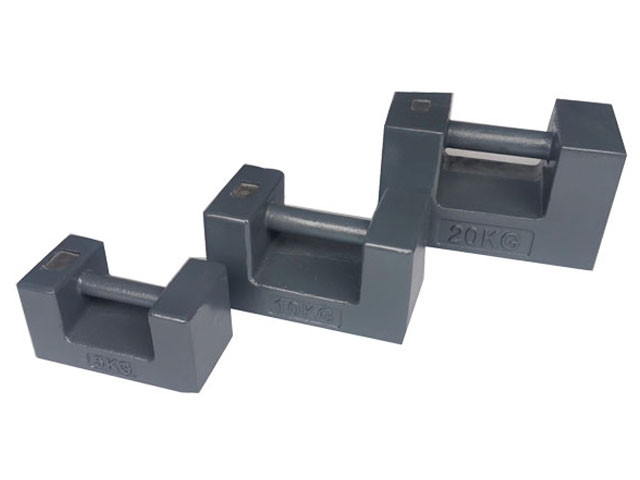
The structural design of F1 cast iron weights is carefully optimized for both functionality and ease of use, with shapes and profiles adapted to suit different handling and application needs. Most standard F1 cast iron weights feature a compact, symmetrical form factor—either cylindrical, square, or rectangular—with smooth, rounded edges to prevent injury during handling and to avoid catching on surfaces or other weights during storage. Larger F1 cast iron weights may include integrated lifting points or contoured grip sections, designed to allow safe, stable handling without direct contact with the main weighing surface, which helps preserve the weight’s finish and prevent contamination from skin oils, dust, or debris. These design choices prioritize practicality without compromising the weight’s precision; every curve, edge, and added feature is calculated to maintain uniform mass distribution across the entire object. Unlike custom-shaped weights for specialized machinery, F1 cast iron weights follow standardized dimensional ratios that ensure consistency across units of the same nominal mass, allowing them to be used interchangeably in calibration setups or stacked together for larger mass verification tasks. This standardization extends to weight stacking compatibility, with flat, level top and bottom surfaces that ensure stable, even stacking without tilting or shifting, which is essential for accurate multi-weight calibration procedures.
Surface treatment is another critical element of F1 class cast iron weight production, as cast iron naturally carries a risk of oxidation and surface rust when exposed to moisture, humidity, or airborne contaminants. To mitigate this, manufacturers apply a controlled, non-additive surface coating that provides long-lasting corrosion resistance without adding significant mass or altering the weight’s calibrated value. The coating is thin, uniform, and tightly bonded to the cast iron substrate, designed to resist chipping, flaking, or peeling during regular use. It creates a barrier between the iron and the surrounding environment, preventing moisture from penetrating the surface and slowing the formation of rust or surface discoloration that could affect mass accuracy over time. This treatment is not overly glossy or decorative; instead, it focuses on functional protection, with a matte or semi-smooth finish that resists dust adhesion and is easy to wipe clean. For use in slightly humid or industrial environments with moderate airborne particles, this surface treatment ensures the weight remains in stable condition, maintaining its mass consistency far longer than untreated cast iron components. Even with this protective coating, proper handling practices are encouraged to preserve the surface integrity, such as avoiding contact with sharp tools, corrosive liquids, or abrasive materials that could scratch or damage the protective layer.
The applications for F1 class cast iron weights span a wide range of professional fields, each relying on their unique combination of precision, durability, and practicality. In industrial manufacturing settings, these weights are commonly used for routine calibration of floor scales, bench scales, and counting scales used in production lines and warehouse operations, where consistent mass verification is essential for accurate inventory management, product packaging, and material dosing. They are also employed in equipment testing and counterbalancing applications, where a fixed, reliable mass is needed to stabilize machinery, test load-bearing capacities, or calibrate tension and weight sensors. Unlike heavier, lower-precision cast iron counterweights, F1 class units provide the added benefit of verified mass consistency, making them suitable for both pure counterbalancing and basic calibration tasks. In technical training environments, such as vocational schools and technical workshops, F1 cast iron weights serve as reliable teaching tools for demonstrating mass measurement principles, balance calibration, and proper weighing techniques, as their sturdy construction can withstand repeated student use without rapid degradation. They are also used in small-scale laboratory settings that perform routine, non-ultra-precision testing, where the cost and fragility of higher-grade precision weights are unnecessary, but a consistent mass reference is still required.
Proper handling and storage practices play a vital role in preserving the performance and lifespan of F1 class cast iron weights, ensuring they retain their calibrated mass and structural integrity for years of use. When handling these weights, it is recommended to use clean, dry gloves or specialized lifting tools to avoid direct skin contact, as natural oils and sweat from hands can leave residues that attract moisture and lead to gradual surface corrosion over time. Weights should be lifted and placed gently, avoiding dropping, dragging, or striking against hard surfaces, as impact can cause subtle structural damage, chipping, or internal stress that may alter mass distribution. After each use, weights should be wiped down with a soft, lint-free, dry cloth to remove dust, dirt, or moisture before being returned to storage. Ideal storage conditions include a clean, dry, temperature-stable environment free from excessive humidity, direct sunlight, or exposure to corrosive fumes or chemicals. Storing weights in a dedicated, padded storage case or on a flat, non-abrasive shelf prevents surface scratches and keeps them separated from other tools that could cause damage. Avoiding prolonged exposure to fluctuating temperatures is also beneficial, as extreme temperature shifts can cause minor expansion and contraction of the cast iron, which, while minimal, can impact long-term stability if exposure is frequent and unregulated.
Over time, even with careful maintenance, F1 cast iron weights may require basic inspection and minor upkeep to ensure continued performance consistency. Regular visual checks for surface rust, scratches, or chipped coating are recommended, as early detection of minor surface issues allows for simple, non-invasive maintenance before they escalate. Light surface discoloration or faint rust spots can be gently addressed with a soft, non-abrasive cleaning agent designed for metal surfaces, followed by thorough drying and a light application of a neutral, non-greasy protective coating to restore the barrier against moisture. It is important to avoid aggressive sanding, scraping, or heavy cleaning methods that could remove material from the weight or alter its mass. For weights used in high-frequency calibration settings, periodic mass verification against a stable reference standard is a practical step to confirm that the unit remains within its intended tolerance range; this verification is focused on performance consistency rather than formal certification, ensuring the weight continues to meet the needs of its intended application. Any weight that shows significant structural damage, such as cracks, deep chips, or warping, should be withdrawn from regular use for assessment, as such damage can compromise both safety and mass accuracy.
What sets F1 class cast iron weights apart from other weighting tools is their unique ability to bridge the gap between basic industrial durability and controlled precision, filling a critical niche in industries and workplaces that cannot afford to compromise on either reliability or accuracy. They do not claim to match the ultra-fine tolerance of higher-grade precision weights, nor are they designed for heavy-duty, high-impact counterbalancing where precision is irrelevant. Instead, they excel in scenarios where consistent, repeatable mass values are needed, paired with a robust construction that can handle the demands of daily industrial or technical use. This balance makes them a staple in countless workplaces, from small manufacturing shops to larger calibration facilities, where practicality and performance go hand in hand. The longevity of well-maintained F1 cast iron weights further adds to their value; with proper care, these weights can remain functional and accurate for many years, outlasting many lighter, less durable weighting alternatives and providing consistent performance throughout their lifespan.
As industrial and calibration needs continue to evolve, the design and production of F1 class cast iron weights have adapted to meet modern demands, with ongoing refinements to casting techniques, material formulation, and surface protection to enhance performance and longevity. Manufacturers focus on refining the consistency of raw material melting, improving mold precision, and optimizing surface treatment processes to reduce minor variations and boost overall quality control, all while staying true to the core traits that define the F1 class: reliable tolerance, sturdy construction, and practical functionality. These weights are not defined by marketing claims or premium branding, but by tangible performance metrics that users can rely on for their daily measurement and calibration tasks. In a world where precise and consistent measurement underpins efficient manufacturing, quality control, and operational safety, F1 class cast iron weights remain a steady, dependable resource, offering a practical solution for professionals who need accurate mass references without unnecessary complexity or fragility. Their enduring relevance stems from their ability to meet real-world needs with straightforward, effective design, proving that practical precision and durable construction will always hold a vital place in industrial and technical workflows.
In summary, cast iron weight class F1 stands as a thoughtfully engineered category of mass reference tools, built to deliver consistent accuracy and long-lasting durability in a wide array of practical settings. From the careful formulation of cast iron material to the precise casting, finishing, and surface treatment processes, every stage of production is focused on maintaining stable mass values and structural reliability. Their versatile design, balanced tolerance profile, and resistance to everyday wear make them suitable for industrial calibration, equipment testing, technical education, and various other applications where dependable mass measurement is essential. By following simple handling, storage, and maintenance practices, users can maximize the lifespan and performance of these weights, ensuring they remain a reliable part of daily operations for years. As a practical middle ground between basic industrial weights and high-precision laboratory tools, F1 class cast iron weights continue to serve as a cornerstone of consistent, accessible mass calibration, adapting to modern workflow needs while retaining the core strength and reliability that define cast iron as a functional industrial material.
